 Back
Thermodynamic Processes: Quasi-static, Isothermal, Adiabatic, and Cyclic Processes
Study Guide - Smart Notes
 Tailored notes based on your materials, expanded with key definitions, examples, and context.
Thermodynamic Processes
Introduction to Thermodynamic Processes
Thermodynamic processes describe how a system changes from one state to another due to interactions with its surroundings. These processes are fundamental to understanding how energy is transferred and transformed in physical and chemical systems. The main thermodynamic variables for an ideal gas are pressure, volume, temperature, and the number of moles.
System: The part of the universe under study (e.g., a gas in a cylinder).
Surroundings: Everything outside the system that can interact with it.
Thermodynamic Variables: Properties such as pressure (p), volume (V), temperature (T), and number of moles (n).
Types of Thermodynamic Processes
Quasi-static and Non-quasi-static Processes
A thermodynamic process is the manner in which a system changes from an initial state to a final state. Processes can be classified as quasi-static (infinitely slow and always in equilibrium) or non-quasi-static (rapid, not always in equilibrium).
Quasi-static Process: Occurs so slowly that the system remains in thermodynamic equilibrium at every stage. All macroscopic properties are well-defined throughout the process. These processes can be represented as well-defined paths on a state diagram.
Non-quasi-static Process: Occurs rapidly, so the system is not in equilibrium during the process. The path between initial and final states is not well-defined.
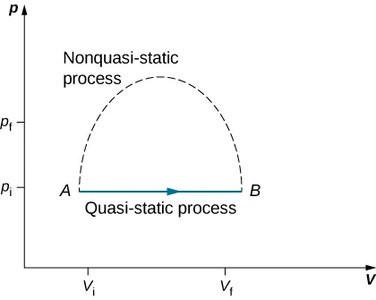
Example: Heating water slowly in a bath (quasi-static) vs. placing it directly in a hot bath (non-quasi-static).
Additional info: In practice, all real processes are non-quasi-static to some extent, but quasi-static processes are studied for their analytical simplicity.
Isothermal Processes
An isothermal process is a thermodynamic process that occurs at constant temperature. This is achieved by keeping the system in thermal equilibrium with a large heat bath whose temperature does not change.
Key Feature: Temperature (T) remains constant throughout the process.
For an ideal gas: The pressure and volume are related by at constant temperature.
Work Done: For a quasi-static isothermal process, the work done by the gas is .
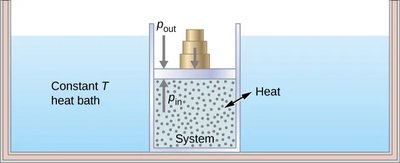
Example: A gas in a cylinder with a movable piston immersed in a water bath at constant temperature. As the piston moves, heat flows in or out to maintain the temperature.
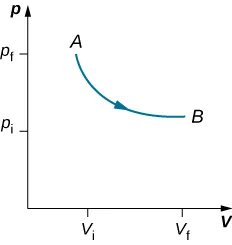
Additional info: Isothermal processes are typically conducted quasi-statically to ensure the temperature remains constant at every stage.
Adiabatic Processes
An adiabatic process is one in which no heat is transferred to or from the system. The system is perfectly insulated, so any change in internal energy is due to work done by or on the system.
Key Feature: (no heat exchange).
Adiabatic Expansion: The system does work on the surroundings, causing its temperature to decrease.
Adiabatic Compression: Work is done on the system, causing its temperature to increase.
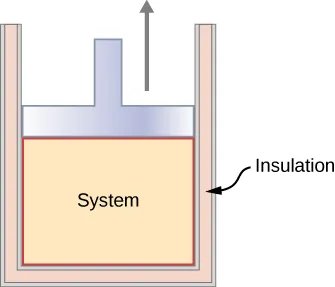
Example: A gas in an insulated cylinder expands, pushing up a piston. No heat enters or leaves, so the temperature drops as the gas does work.
Additional info: Adiabatic processes can be quasi-static or non-quasi-static, but are often idealized as quasi-static for analysis.
Cyclic Processes
A cyclic process is one in which the system returns to its original state after a series of processes. All state properties (T, p, V, internal energy) are unchanged after a complete cycle.
Key Feature: over a complete cycle.
First Law of Thermodynamics for a Cycle: (the net heat added equals the net work done over the cycle).
Example: The operation of a heat engine, where the working substance undergoes a series of processes and returns to its initial state.
Other Common Thermodynamic Processes
Isobaric Process: Pressure remains constant ().
Isochoric Process: Volume remains constant ().
Additional info: Many real-world processes do not fit perfectly into these categories but can often be approximated as such for analysis.
Reversible and Irreversible Processes
A reversible process is one that can be reversed by infinitesimal changes in the environment, retracing its path in state space. All reversible processes are quasi-static, but not all quasi-static processes are reversible (e.g., if friction is present).
Reversible: No dissipative effects (like friction); can return to original state without net energy loss.
Irreversible: Involves dissipative effects; cannot return to original state without energy loss.
Summary Table: Types of Thermodynamic Processes
Process Type | Constant Variable | Heat Exchange (Q) | Example |
|---|---|---|---|
Isothermal | Temperature (T) | Heat flows to maintain T | Gas in a water bath at constant T |
Adiabatic | No heat exchange (Q = 0) | None | Gas in an insulated cylinder |
Isobaric | Pressure (p) | Heat may flow | Heating water at atmospheric pressure |
Isochoric | Volume (V) | Heat may flow | Heating gas in a rigid container |
Cyclic | Returns to initial state | Net Q = Net W | Heat engine cycle |
