 Back
Thermodynamic Systems and Equilibrium: Study Notes
Study Guide - Smart Notes
 Tailored notes based on your materials, expanded with key definitions, examples, and context.
Thermodynamic Systems
Definition and Components
A thermodynamic system is any collection of matter whose thermodynamic properties are under study. The system is separated from its surroundings by a boundary, which can be real or imaginary. The boundary defines what is included in the system and what is not.
System: The part of the universe being studied (e.g., gas in a cylinder).
Boundary: The interface separating the system from its surroundings (e.g., walls of a cylinder).
Surroundings: Everything outside the system (e.g., air, piston, radiator).
Systems interact with their surroundings by exchanging energy (heat or work) and, in some cases, matter.
Types of Thermodynamic Systems
Thermodynamic systems are classified based on their ability to exchange energy and matter with their surroundings:
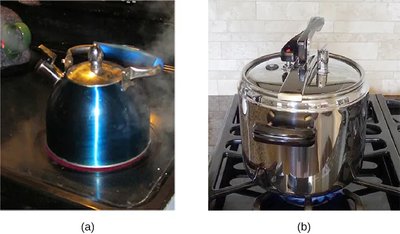
Open System: Exchanges both energy and matter with surroundings (e.g., boiling tea kettle).
Closed System: Exchanges energy but not matter (e.g., pressure cooker).
Isolated System: Exchanges neither energy nor matter (idealized, rarely exists in practice).
Example: A boiling tea kettle is an open system because it transfers heat and releases steam to its surroundings. A pressure cooker is a good approximation of a closed system, as it retains most steam and only releases a small amount to prevent explosion.
Thermal Equilibrium and Temperature
Thermal Equilibrium
Thermal equilibrium occurs when two objects in thermal contact no longer exchange heat, meaning their temperatures are equal. This concept is fundamental in thermodynamics for defining temperature.
When a system is in thermal equilibrium, its properties are uniform throughout.
Thermal equilibrium is required for meaningful thermodynamic analysis.
Zeroth Law of Thermodynamics
The zeroth law of thermodynamics establishes the concept of temperature:
If object 1 is in thermal equilibrium with objects 2 and 3, then objects 2 and 3 are also in thermal equilibrium.
Mathematical Expression:
This law allows us to use thermometers to measure temperature consistently.
Macroscopic Properties and Equation of State
Macroscopic Properties
Thermodynamic systems are described by macroscopic properties such as volume, pressure, and temperature. These are averages of microscopic properties and are assumed to be uniform in equilibrium.
Volume (V): Space occupied by the system.
Pressure (p): Force per unit area exerted by the system.
Temperature (T): Measure of thermal energy.
Equation of State
An equation of state relates the macroscopic properties of a system. For a closed system, it is written as:
For an ideal gas, the equation of state is:
where n is the number of moles and R is the gas constant.
Extensive and Intensive Variables
Classification of Variables
Thermodynamic properties are classified as extensive or intensive:
Extensive Variables: Depend on the amount of matter (e.g., volume, energy, number of moles). Doubling the system doubles these values.
Intensive Variables: Independent of the amount of matter (e.g., pressure, temperature). Remain unchanged if the system size changes.
Example: If you double the amount of water in a tank (while keeping temperature and pressure constant), the volume doubles (extensive), but the temperature and pressure remain the same (intensive).
Summary Table: Types of Thermodynamic Systems
System Type | Exchanges Energy? | Exchanges Matter? | Example |
|---|---|---|---|
Open | Yes | Yes | Boiling tea kettle |
Closed | Yes | No | Pressure cooker |
Isolated | No | No | Thermally insulated container (idealized) |
