 Back
9 Thermodynamics: Energy, Work, and the First Law
Study Guide - Smart Notes
 Tailored notes based on your materials, expanded with key definitions, examples, and context.
Thermodynamics: Energy, Work, and the First Law
Introduction to Thermodynamics
Thermodynamics is the branch of science that deals with the relationships between heat, work, and energy, and how these quantities affect matter. It is fundamental to understanding chemical reactions, phase changes, and energy transfer in physical and chemical systems.
Energy Descriptors and Work
Forms of Energy
Kinetic Energy (KE): Energy due to motion. For a mass m moving at velocity v, .
Potential Energy (PE): Energy due to position. For a mass m at height h in a gravitational field, .
Internal Energy (U): The sum of all microscopic forms of energy (translational, rotational, vibrational, and potential energies of molecules).
Work and Energy Transfer
Work is a means of transferring energy into or out of a thermodynamic system. In chemistry, we often focus on boundary work, which occurs when the volume of a system changes under pressure.
Work done by the system: Energy leaves the system (e.g., gas expands against external pressure).
Work done on the system: Energy enters the system (e.g., gas is compressed).
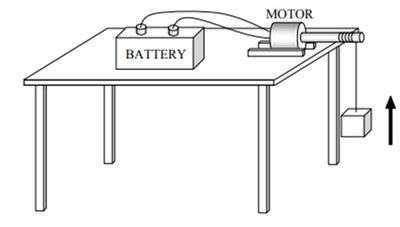
Example: A battery-powered motor lifts a box, converting chemical energy from the battery into mechanical work, increasing the gravitational potential energy of the box.
Phase Changes and Diagrams
Phase Diagram (Pressure-Temperature Diagram)
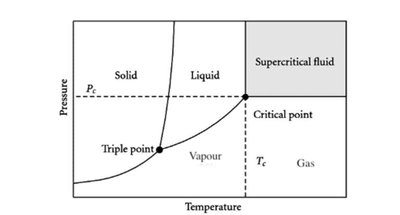
A phase diagram shows the state of a substance (solid, liquid, gas) at various pressures and temperatures. Key features include:
Fusion curve: Separates solid and liquid phases (melting/freezing).
Vaporization curve: Separates liquid and vapor phases (boiling/condensation).
Sublimation curve: Separates solid and vapor phases (sublimation/deposition).
Triple point: The unique set of conditions where all three phases coexist.
Critical point: The end point of the vaporization curve, beyond which the substance is a supercritical fluid.
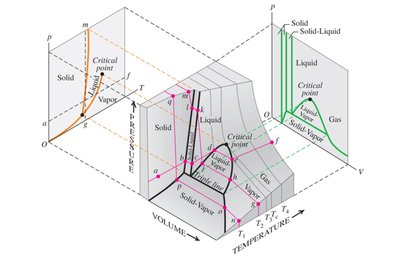
Pressure-Volume-Temperature (PVT) Surface
The PVT surface is a three-dimensional representation showing how pressure, volume, and temperature are interrelated for a substance. Projections onto the PT and PV planes help visualize phase boundaries and critical points.
PV Diagrams
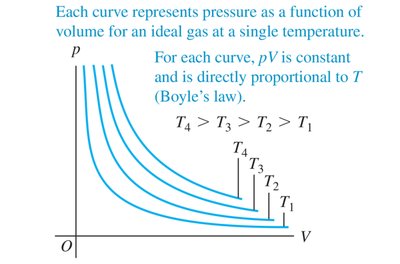
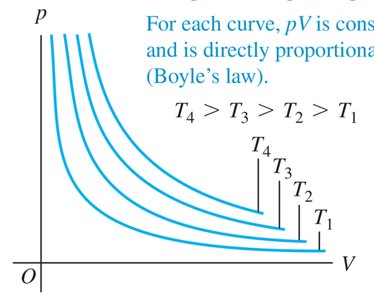
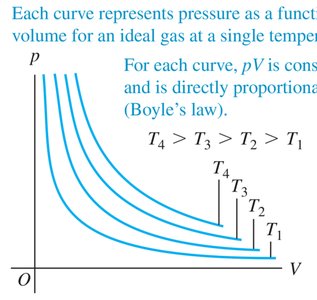
PV diagrams plot pressure (P) versus volume (V) and are used to analyze thermodynamic processes. Isotherms (lines of constant temperature) are shown for different temperatures.
Isothermal process: Temperature remains constant ().
Isobaric process: Pressure remains constant ().
Isochoric process: Volume remains constant ().
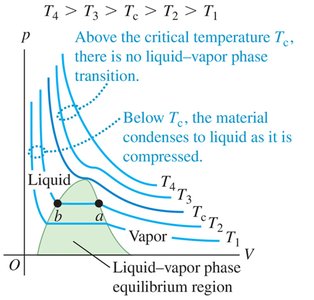
PV Diagram for an Ideal Gas
For an ideal gas, the relationship between pressure, volume, and temperature is given by the ideal gas law:
Each isotherm on the PV diagram represents a state where the temperature is constant. Boyle's Law describes the inverse relationship between pressure and volume at constant temperature:
Internal Energy and the First Law of Thermodynamics
Thermodynamic Systems
A thermodynamic system is a defined part of the universe under study, separated by boundaries from its surroundings. Energy can be exchanged with the surroundings as heat or work.
Closed system: Exchanges energy but not matter with surroundings.
Open system: Exchanges both energy and matter.
Isolated system: Exchanges neither energy nor matter.
Energy Transfer: Heat and Work
Heat (Q): Energy transferred due to temperature difference.
Work (W): Energy transferred when a force moves an object.
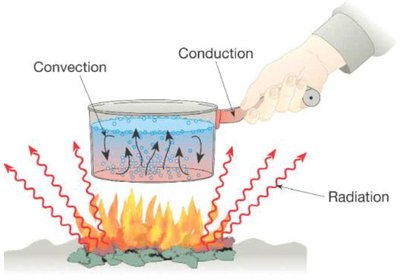
Three modes of heat transfer:
Conduction: Direct transfer through contact.
Convection: Transfer by movement of fluid.
Radiation: Transfer by electromagnetic waves.
First Law of Thermodynamics (Law of Conservation of Energy)
The first law states that energy cannot be created or destroyed, only transformed. For a closed system:
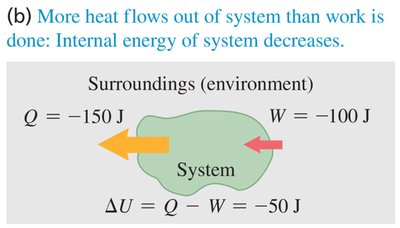
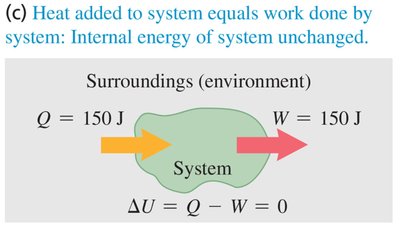
Where is the change in total energy (internal, kinetic, and potential), is heat added to the system, and is work done by the system.
If changes in kinetic and potential energy are negligible:
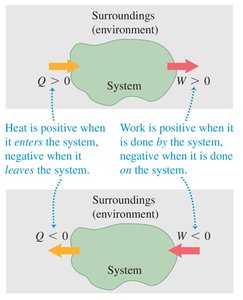
Sign Convention in Thermodynamics
Heat (Q): Positive when added to the system, negative when released.
Work (W): Positive when done by the system, negative when done on the system.
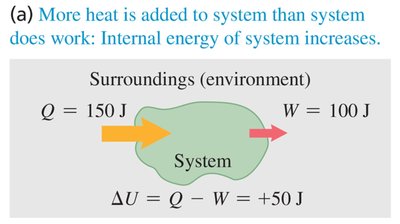
Examples of the First Law
Case 1: More heat added than work done:
Case 2: More heat leaves than work done:
Case 3: Heat added equals work done:
Thermodynamic Processes
Types of Processes
Isobaric: Constant pressure ()
Isothermal: Constant temperature ()
Isochoric: Constant volume ()
Adiabatic: No heat exchange (), so

Thermodynamic Cycles vs. Processes
Thermodynamic process: The path taken by a system from one state to another.
Thermodynamic cycle: A series of processes that return a system to its initial state.
Summary Table: Key Thermodynamic Quantities
Quantity | Symbol | Definition | Sign Convention |
|---|---|---|---|
Heat | Q | Energy transferred due to temperature difference | + into system, - out of system |
Work | W | Energy transferred by force acting over distance | + by system, - on system |
Internal Energy | U | Total microscopic energy (kinetic + potential) | State function |
Change in Internal Energy | ΔU | ΔU = Q - W | Depends on Q and W |
Reflection Questions
Is it possible for the temperature of a system to remain constant when heat flows into or out of it? (Yes, in an isothermal process, heat flow is balanced by work done.)
Does adding heat to a system always result in an increase in internal energy? (No, if the system does work, internal energy may not increase.)
When a gas expands in a piston, is work done on or by the system? (By the system.)
Is more work required to inflate a balloon at sea level or on Mount Everest? (At sea level, due to higher external pressure.)
Can internal energy change in a closed, rigid cylinder with no heat exchange? (Yes, if work is done by other means, such as electrical work.)
What is the difference between macroscopic PE/KE and internal energy? (Macroscopic PE/KE refer to the bulk motion or position of the system, while internal energy is due to molecular motion and interactions.)
