 Back
BackThermodynamics: Entropy and Spontaneity in Chemistry
Study Guide - Smart Notes
 Tailored notes based on your materials, expanded with key definitions, examples, and context.
Thermodynamics: Entropy
Introduction to Entropy and Thermodynamics
Thermodynamics is a branch of chemistry that studies the flow and transformation of energy in chemical systems. One of its central concepts is entropy, which describes the tendency of energy and matter to spread out and become more disordered over time. This concept is crucial for understanding why certain chemical processes occur spontaneously, while others do not.
Spontaneity and the Second Law of Thermodynamics
Spontaneous vs. Nonspontaneous Processes
A spontaneous process is one that occurs without ongoing external intervention. Examples include a ball rolling downhill, iron rusting, or water boiling at 373 K. In contrast, nonspontaneous processes require continuous input of energy, such as lifting a book or boiling water at 273 K. Importantly, spontaneity does not imply anything about the speed of a process.
Spontaneous: Occurs naturally, without outside help.
Nonspontaneous: Requires external energy or intervention.
Spontaneity ≠ Speed: A process can be spontaneous but extremely slow (e.g., diamond turning into graphite).

Kinetics vs. Thermodynamics
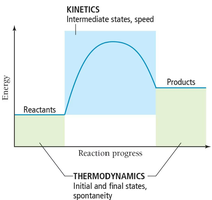
Kinetics deals with the rate at which a reaction proceeds, while thermodynamics determines whether a reaction is energetically favorable (spontaneous). A reaction can be thermodynamically favorable but kinetically slow.
Chemical and Mechanical Potential
Potential Energy in Chemistry
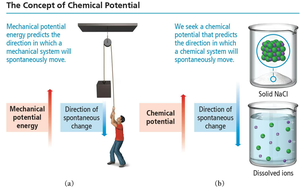
Systems with high potential energy tend to move toward lower energy states. In chemistry, we use the concept of chemical potential to predict the direction of spontaneous change in a system, analogous to how mechanical potential energy predicts motion in physics.
Enthalpy as Chemical Potential
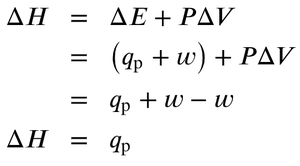
Enthalpy (H) is a measure of the total energy of a system, including internal energy and the energy required to make room for it by displacing its environment. At constant pressure, the change in enthalpy equals the heat exchanged. However, not all exothermic reactions are spontaneous, and not all endothermic reactions are nonspontaneous—entropy must also be considered.
Exothermic: Releases energy,
Endothermic: Absorbs energy,
Entropy: Definition and Significance
What is Entropy?
Entropy (S) is a measure of the randomness or disorder of a system. It quantifies the number of ways a system's components can be arranged while maintaining the same overall state. The second law of thermodynamics states that the total entropy of an isolated system always increases over time, defining the direction of spontaneous processes and the arrow of time.
Units: Energy/Temperature (e.g., J/K)
Key Principle: Energy and matter tend to spread out, increasing entropy.
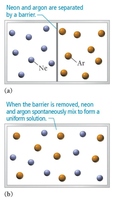
Entropy and State Changes
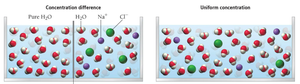
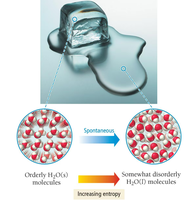
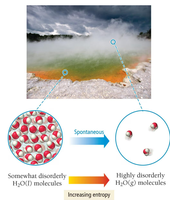
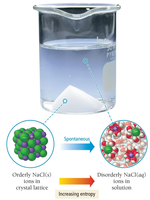
Entropy increases during phase changes that result in greater molecular disorder, such as melting (solid to liquid), vaporization (liquid to gas), or dissolving a solid in a solvent. These processes are often spontaneous because they increase the system's entropy.
Solid to Liquid: Orderly structure becomes more disordered.
Liquid to Gas: Molecules become highly disordered.
Dissolving: Ions or molecules become more dispersed in solution.
Statistical Definition of Entropy
Boltzmann's Equation
Ludwig Boltzmann provided a statistical definition of entropy, relating it to the number of microstates (W) corresponding to a macrostate:
k: Boltzmann constant ()
W: Number of microstates (ways to arrange the system)
Macrostate: Observable state (e.g., total energy, pressure, volume, temperature)
Microstate: Specific arrangement of particles (positions, velocities)

Microstates and Macrostates
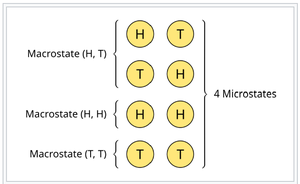
Each macrostate can be realized by many different microstates. For example, flipping two coins yields four microstates (HH, HT, TH, TT) but only three macrostates (0 heads, 1 head, 2 heads). The macrostate with the most microstates is the most probable and has the highest entropy.
Entropy in Gases and Probability
Entropy of an Ideal Gas
Consider an ideal gas with several particles. If all particles are confined to one side of a container, there are few microstates. When allowed to spread out, the number of possible arrangements (microstates) increases, and so does entropy. The most probable state is the one with the highest entropy—particles evenly distributed.
Probability: The probability of all particles being on one side decreases rapidly as the number of particles increases.
Spreading Out: The even distribution is overwhelmingly more likely.
The Second Law of Thermodynamics (Restated)
Entropy and Spontaneity
The second law can be restated: spontaneous processes are those that increase the total entropy of the universe. High-entropy macrostates are more likely, and thus, events that increase entropy tend to happen spontaneously.
Energy and matter tend to spread out.
Spontaneous processes increase entropy.
Entropy in Chemistry: Applications and Calculations
Entropy and Phase Changes
Entropy changes are especially significant during phase changes. For example, melting ice at 273 K is a reversible process, while melting at 270 K is irreversible. The entropy change for a reversible process can be calculated using the enthalpy of fusion and the temperature at which the process occurs:
qrev: Heat absorbed or released in a reversible process
T: Absolute temperature (in Kelvin)
Entropy and Stoichiometry
Entropy increases when the number of moles of gas increases in a chemical reaction. This is often observed in reactions where solids or liquids produce gases, or when the number of product molecules exceeds the number of reactant molecules.
Summary
Entropy is a measure of disorder and the number of ways a system can be arranged.
The second law of thermodynamics states that entropy tends to increase in spontaneous processes.
Spontaneity depends on both enthalpy and entropy changes.
Statistical mechanics provides a deeper understanding of entropy through microstates and macrostates.
Entropy changes are important in phase transitions, chemical reactions, and mixing processes.
