 Back
10 & 11 Thermodynamics: Work, Internal Energy, Heat Capacities, and Adiabatic Processes
Study Guide - Smart Notes
 Tailored notes based on your materials, expanded with key definitions, examples, and context.
Thermodynamic Processes
State Variables and Types of Processes
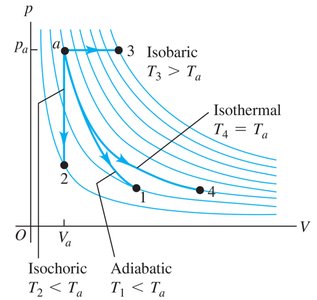
Thermodynamic processes describe how a system changes from one state to another, characterized by variables such as pressure (P), volume (V), and temperature (T). The path taken between states determines the process type and the energy exchanges involved.
Isobaric Process: Pressure remains constant (P = constant).
Isochoric Process: Volume remains constant (V = constant).
Isothermal Process: Temperature remains constant (T = constant).
Adiabatic Process: No heat is exchanged with the surroundings (Q = 0).
Each process can be represented on a P-V diagram, where the area under the curve corresponds to the work done by or on the system.
Thermodynamic Cycles
A thermodynamic cycle occurs when a system undergoes a series of processes and returns to its initial state. In a cycle, the net change in internal energy is zero, but work and heat may be exchanged during the cycle.
Example: The Carnot cycle, Otto cycle, and refrigeration cycles are common thermodynamic cycles.
The First Law of Thermodynamics
Statement and Sign Convention
The First Law of Thermodynamics expresses the conservation of energy for thermodynamic systems:
ΔU: Change in internal energy of the system
Q: Heat added to the system (positive if entering the system)
W: Work done by the system (positive if done by the system on the surroundings)
Work in Thermodynamic Processes
Path Dependence and Boundary Work
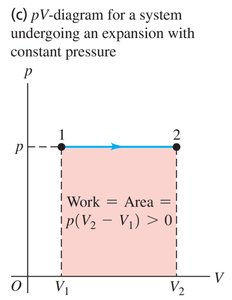
The work done by a system during a process depends on the path taken between the initial and final states. For a quasi-static process:
Isochoric Process (V = constant):
Isobaric Process (P = constant):
Isothermal Process (T = constant, ideal gas):
Internal Energy of an Ideal Gas
Definition and Dependence
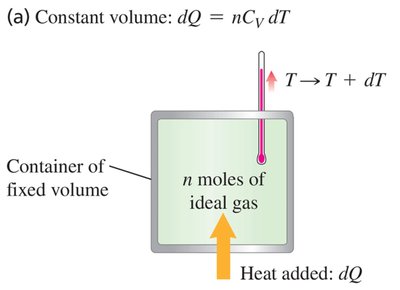
The internal energy (U) of an ideal gas is the sum of the microscopic kinetic energies of its molecules. For an ideal gas, internal energy depends only on temperature and the number of moles:
n: Number of moles
C_v: Molar heat capacity at constant volume
ΔT: Change in temperature (in Kelvin)
For a monoatomic ideal gas, .
Heat Capacities of an Ideal Gas
Constant Volume and Constant Pressure
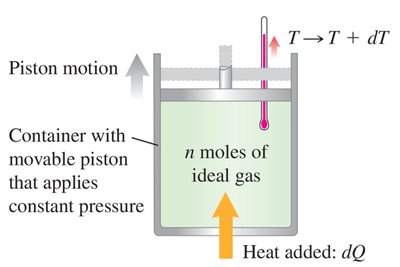
The molar heat capacity is the amount of heat required to raise the temperature of one mole of a substance by one Kelvin.
At constant volume (C_v):
At constant pressure (C_p):
For an ideal gas:
where is the universal gas constant ().
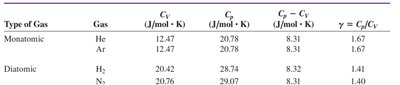
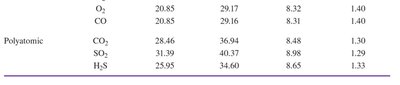
Molar Heat Capacities of Gases at Low Pressure
The following table summarizes the molar heat capacities for various gases:
Type of Gas | Gas | C_v (J/mol·K) | C_p (J/mol·K) | C_p - C_v (J/mol·K) | γ = C_p/C_v |
|---|---|---|---|---|---|
Monatomic | He | 12.47 | 20.78 | 8.31 | 1.67 |
Monatomic | Ar | 12.47 | 20.78 | 8.31 | 1.67 |
Diatomic | H₂ | 20.42 | 28.74 | 8.32 | 1.41 |
Diatomic | N₂ | 20.76 | 29.07 | 8.31 | 1.40 |
Diatomic | O₂ | 20.85 | 29.17 | 8.32 | 1.40 |
Diatomic | CO | 20.85 | 29.16 | 8.31 | 1.40 |
Polyatomic | CO₂ | 28.46 | 36.94 | 8.48 | 1.30 |
Polyatomic | SO₂ | 31.39 | 40.37 | 8.98 | 1.29 |
Polyatomic | H₂S | 25.95 | 34.60 | 8.65 | 1.33 |
Adiabatic Processes
Definition and Equations
An adiabatic process is one in which no heat is transferred to or from the system (Q = 0). For an ideal gas, the first law simplifies to:
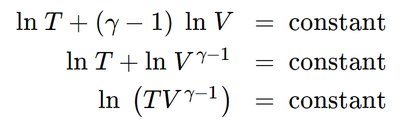
Key relationships for adiabatic processes (for an ideal gas):
Where
Summary of Key Equations
First Law:
Isochoric: ,
Isobaric: ,
Isothermal (ideal gas):
Adiabatic: , ,
Examples and Applications
Example: Isobaric Expansion
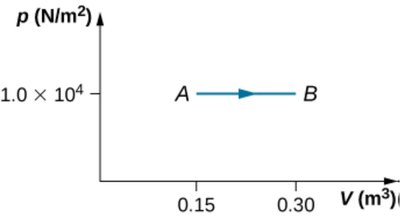
A gas expands from 0.15 m³ to 0.30 m³ at a constant pressure of N/m². The work done by the gas is:
Example: Isochoric Heating
3.0 moles of a monoatomic gas in a rigid container are heated, raising the temperature by 10 K. The change in internal energy is:
Example: Adiabatic Compression
Air is compressed adiabatically from an initial volume of 1.00 L to a final volume of 1/15 of the initial volume. Given , K, Pa:
Final temperature:
Final pressure:
Reflection Questions
When a gas expands adiabatically, where does the energy for work come from?
How does internal energy change during adiabatic expansion or compression?
How does the first law simplify for isothermal processes?
Why is always greater than 1 for ideal gases?
When can you use ?
