 Back
Three Major Classes of Chemical Reactions: Solution Chemistry, Precipitation, Acid-Base, and Redox Reactions
Study Guide - Smart Notes
 Tailored notes based on your materials, expanded with key definitions, examples, and context.
Solution Concentration and the Role of Water as a Solvent
Definition and Properties of Solutions
A solution is a homogeneous mixture with uniform composition and no visible boundaries between its components. It consists of at least one solute (the substance dissolved, usually in smaller quantity) and one solvent (the substance in which the solute dissolves, usually in larger quantity). In aqueous solutions, water acts as the solvent.
Concentration refers to the quantity of solute dissolved in a given quantity of solution or solvent.
Many chemical reactions occur in solution, making concentration a critical parameter.
Molarity and Solution Calculations
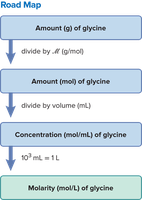
Molarity (M) is the most common unit for expressing solution concentration, defined as moles of solute per liter of solution:
Formula: $M = \frac{\text{moles of solute}}{\text{liters of solution}}$
To calculate molarity, convert mass of solute to moles using molar mass, then divide by volume in liters.
Mass-Mole-Number-Volume Relationships in Solution
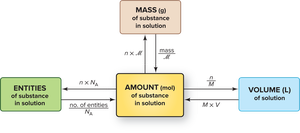
Understanding the relationships between mass, moles, number of entities, and volume is essential for solution calculations:
Mass (g) → Amount (mol): Divide by molar mass.
Amount (mol) → Number of entities: Multiply by Avogadro's number ($N_A$).
Amount (mol) → Volume (L): Divide by molarity.
Preparing Dilute Solutions from Concentrated Solutions
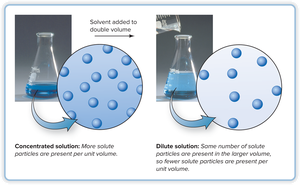
To dilute a concentrated solution, solvent is added, keeping the moles of solute constant. The relationship is given by:
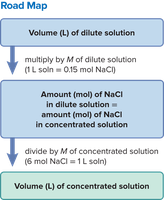
$C_1V_1 = C_2V_2$ (where $C$ is concentration and $V$ is volume)
Example: To prepare 0.80 L of 0.15 M NaCl from a 6.0 M stock, use $V_1 = \frac{C_2V_2}{C_1}$
The Polar Nature of Water
Structure and Solvent Properties
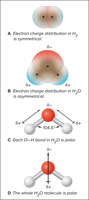
Water's exceptional solvent power arises from its polar nature, due to uneven electron distribution and bent molecular shape:
Each O-H bond is polar, and the overall molecule is polar.
This polarity enables water to dissolve many ionic and polar substances.
Dissolution of Ionic Compounds in Water
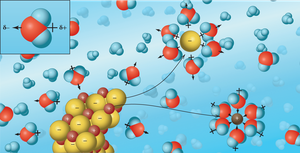
When ionic compounds dissolve in water, ions are surrounded by water molecules, stabilizing them in solution:
Water molecules orient their partial charges to surround cations and anions.
This process is called hydration.
Electrical Conductivity of Ionic Solutions
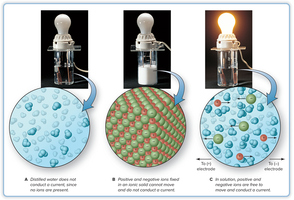
Ionic solutions conduct electricity due to the presence of free-moving ions:
Distilled water does not conduct electricity (no ions).
Solid ionic compounds do not conduct (ions fixed in lattice).
Ionic solutions conduct well (ions are free to move).
Precipitation Reactions
Definition and Process
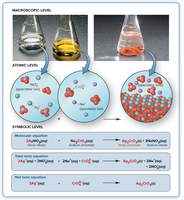
A precipitation reaction occurs when two soluble ionic compounds react to form an insoluble product (precipitate), removing ions from solution.
More than one precipitate may form.
Three types of equations represent these reactions: molecular, total ionic, and net ionic equations.
Writing Equations for Aqueous Ionic Reactions
Equations for precipitation reactions can be written at different levels:
Molecular equation: Shows reactants and products as intact compounds.
Total ionic equation: Shows all soluble ionic substances dissociated into ions.
Net ionic equation: Shows only the ions and molecules directly involved in the chemical change, omitting spectator ions.
Acid-Base Reactions
Acids, Bases, and Neutralization
An acid produces H+ ions in water, while a base produces OH− ions. Acid-base reactions are also called neutralization reactions.
H+ ions interact strongly with water, forming H3O+ (hydronium ion).
Strong acids and bases dissociate completely; weak acids and bases dissociate only partially.
Oxidation-Reduction (Redox) Reactions
Definitions and Agents
Oxidation is the loss of electrons; reduction is the gain of electrons. The oxidizing agent gains electrons and is reduced, while the reducing agent loses electrons and is oxidized. Redox reactions involve electron transfer and always occur together.
Oxidation numbers are assigned to atoms to track electron transfer.
Combination, decomposition, displacement, and combustion are types of redox reactions.
The Equilibrium State
Reversibility and Equilibrium
Chemical reactions can be reversible, reaching an equilibrium state where the rates of forward and reverse reactions are equal. At equilibrium, concentrations of reactants and products remain constant over time.
Additional info: These notes cover solution chemistry, precipitation, acid-base, and redox reactions, including calculation methods, molecular structure, and reaction types. Tables referenced in the original material (e.g., solubility rules, strong/weak acids and bases) are not included here but are essential for full mastery of the topics.
