 Back
BackTracking Energy in Chemical Reactions: Bond Energies and Thermochemistry
Study Guide - Smart Notes
 Tailored notes based on your materials, expanded with key definitions, examples, and context.
Tracking Energy in Chemical Reactions
Introduction to Chemical Energy Changes
Chemical reactions involve the rearrangement of atoms and the redistribution of electrons, leading to changes in the internal potential energy of the system. Understanding how energy is absorbed or released during these processes is central to predicting reaction behavior and evaluating energy sources.
Modeling Chemical Reactions
Atomic Rearrangement and Energy
During a chemical reaction, the atoms in the reactants are rearranged to form products with different compositions and structures. This rearrangement involves breaking and forming chemical bonds, which is always accompanied by energy changes.
Assumption 1: Chemical reactions rearrange atoms, forming new particles with different structures.
Assumption 2: Electron redistribution during reactions changes the internal potential energy of the system.
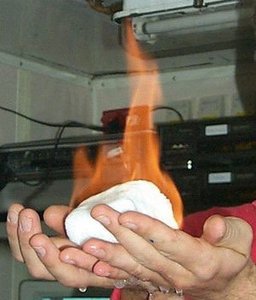
Energy Transfer: System and Surroundings
Energy changes in chemical reactions are often observed as heat transfer between the system (the reacting chemicals) and the surroundings. The direction of heat flow determines whether a reaction is exothermic or endothermic.
Exothermic Process: The system releases energy to the surroundings (ΔH < 0).
Endothermic Process: The system absorbs energy from the surroundings (ΔH > 0).
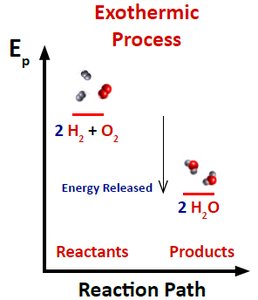
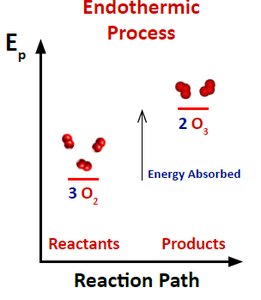
Bond Energies and Chemical Change
Bond Breaking and Bond Formation
The energy required to break a chemical bond is called the bond dissociation energy (or simply bond energy). Conversely, energy is released when a new bond is formed between atoms. The net energy change in a reaction depends on the total energy required to break bonds in the reactants and the total energy released when new bonds form in the products.
Breaking Bonds: Always requires energy (endothermic process).
Forming Bonds: Always releases energy (exothermic process).
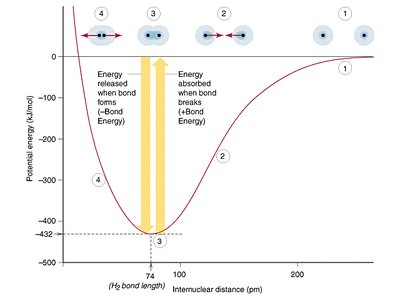
Bond Energy Table
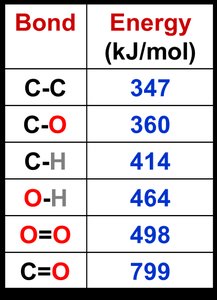
Bond energies vary depending on the atoms involved and the type of bond (single, double, triple). The following table summarizes typical bond energies:
Bond | Energy (kJ/mol) |
|---|---|
C–C | 347 |
C–O | 360 |
C–H | 414 |
O–H | 464 |
O=O | 498 |
C=O | 799 |

Potential Energy Diagrams
Potential energy diagrams illustrate the energy changes during bond breaking and formation. The minimum point on the curve represents the most stable arrangement (bonded atoms), while energy must be supplied to separate the atoms (break the bond).
Calculating the Heat of Reaction (ΔHrxn)
General Approach
The enthalpy change for a reaction can be estimated using bond energies:
Sum the energies required to break all bonds in the reactants.
Sum the energies released when new bonds form in the products.
The net enthalpy change is:
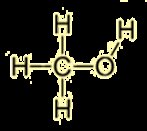
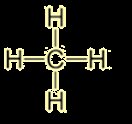
Example: Combustion of Methane
The combustion of methane is a classic exothermic reaction:
Using bond energies:
Bonds broken: 4 C–H, 2 O=O
Bonds formed: 2 C=O, 4 O–H
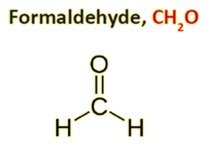
Example: Combustion of Formaldehyde
Trends in Energy Release and Fuel Evaluation
Degree of Oxidation and Energy Release
The amount of energy released during combustion depends on the degree of oxidation of the fuel. Fuels that require more O2 reactant (less oxygenated) release more energy per mole, while oxygenated fuels release less energy but tend to produce fewer pollutants.
More O2 required → More energy released
Oxygenated fuels → Less energy per mole, but cleaner combustion
Energy Density: kJ/g and Cal/g
Energy density is a useful metric for comparing fuels, as it expresses the energy released per unit mass. This is especially important for practical applications such as transportation fuels and food energy content.
1 calorie (cal) = 4.184 J
1 Calorie (Cal) = 1 kcal = 1000 cal
For example, glucose (C6H12O6) and oleic acid (C18H34O2) have different energy densities, which can be calculated as follows:
Summary Table: Bond Energies
Bond | Energy (kJ/mol) |
|---|---|
C–C | 347 |
C–O | 360 |
C–H | 414 |
O–H | 464 |
O=O | 498 |
C=O | 799 |
Key Takeaways
Chemical reactions involve breaking and forming bonds, with associated energy changes.
Exothermic reactions release energy; endothermic reactions absorb energy.
Bond energies can be used to estimate the enthalpy change of a reaction.
Energy density is a practical measure for comparing fuels and food energy content.
