 Back
Transcription, RNA Processing, and Translation: A Mini-Textbook Study Guide
Study Guide - Smart Notes
 Tailored notes based on your materials, expanded with key definitions, examples, and context.
Transcription: The First Step in Gene Expression
Overview of Transcription
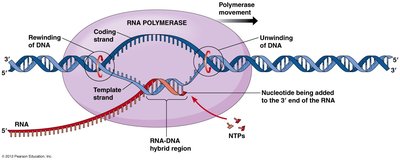
Transcription is the process by which genetic information encoded in DNA is copied into RNA. This is the first step in gene expression and occurs in the nucleus of eukaryotic cells. The enzyme responsible for this process is RNA polymerase, which synthesizes RNA by linking ribonucleotides complementary to the DNA template strand.
RNA polymerase catalyzes the synthesis of RNA in the 5′ → 3′ direction.
Unlike DNA polymerase, RNA polymerase does not require a primer.
Only one DNA strand serves as the template; the other is the coding strand.
Bacteria have one RNA polymerase; eukaryotes have three (Pol I, II, III).
Mechanism of Transcription
Transcription involves the unwinding of DNA, pairing of ribonucleotides to the template strand, and formation of phosphodiester bonds.
Hydrogen bonds form between complementary base pairs.
Phosphodiester linkage is formed after base pairing.
RNA-DNA hybrid region exists temporarily during synthesis.
Three Steps of Transcription
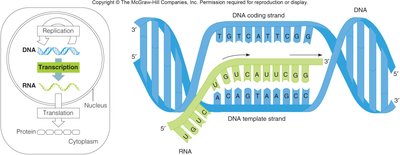
Transcription occurs in three main steps:
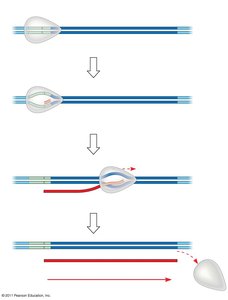
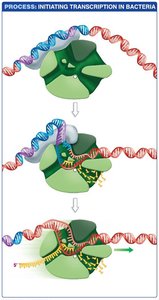
Initiation: RNA polymerase and transcription factors bind to the promoter region.
Elongation: RNA polymerase synthesizes RNA, unwinding DNA as it moves.
Termination: Transcription ends when a terminator sequence is reached.
Promoters and Initiation of Transcription
Bacterial Promoters
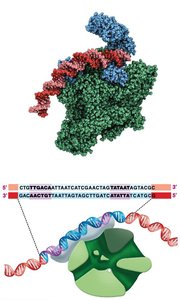
Promoters are DNA sequences that define where transcription begins and which strand is used as the template. In bacteria, promoters contain conserved sequences known as the –10 (TATAAT) and –35 (TTGACA) boxes.
Sigma factors bind to promoters and orient RNA polymerase.
Promoter orientation determines transcription direction.
Eukaryotic Promoters
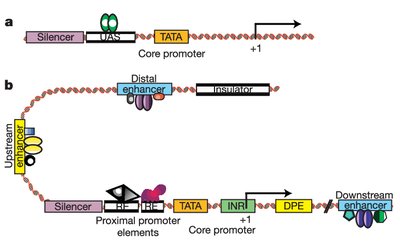
Eukaryotic promoters are more complex and variable. The TATA box is a common element, but other elements like INR and DPE are also present.
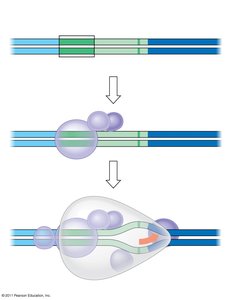
General transcription factors (GTFs) are required for RNA polymerase II binding.
The transcription initiation complex forms at the promoter.
RNA Processing in Eukaryotes
Post-Transcriptional Modifications
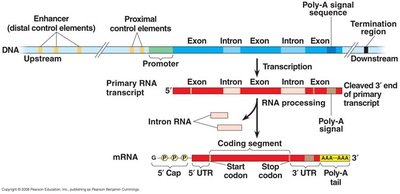
Eukaryotic primary transcripts (pre-mRNA) undergo several modifications before becoming mature mRNA:
5' Capping: Addition of a modified guanine nucleotide to the 5' end.
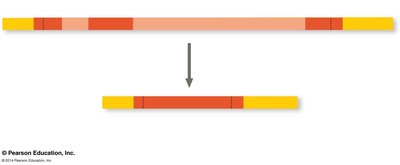
Splicing: Removal of introns and joining of exons.
Polyadenylation: Addition of a poly-A tail to the 3' end.
RNA Splicing
Splicing is catalyzed by the spliceosome, a complex of snRNPs and proteins. Introns are removed, and exons are joined to form a continuous coding sequence.
Alternative splicing allows for multiple proteins from a single gene.
Exon shuffling can lead to new protein functions.
Translation: Protein Synthesis
Overview of Translation
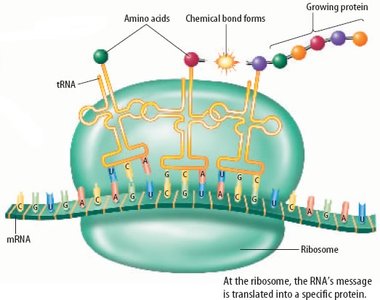
Translation is the process by which the sequence of bases in mRNA is converted into an amino acid sequence in a protein. This occurs on ribosomes in the cytoplasm.
mRNA is read in codons (three-base units).
tRNAs bring specific amino acids to the ribosome.
Ribosomes catalyze peptide bond formation.
Stages of Translation
Translation consists of three stages:
Initiation: Assembly of the ribosome, mRNA, and initiator tRNA.
Elongation: Sequential addition of amino acids to the growing polypeptide.
Termination: Release of the completed polypeptide when a stop codon is encountered.
Structure and Function of tRNA and Ribosomes
tRNA Structure and Function
tRNA molecules are adaptors that translate mRNA codons into amino acids. Each tRNA has an anticodon and an amino acid attachment site.
tRNAs are charged by aminoacyl-tRNA synthetases.
Wobble base pairing allows flexibility at the third codon position.
Ribosome Structure
Ribosomes consist of large and small subunits, each made of proteins and rRNA. They have three binding sites for tRNA: A (aminoacyl), P (peptidyl), and E (exit).
rRNA catalyzes peptide bond formation.
Bacterial and eukaryotic ribosomes differ in structure and sensitivity to antibiotics.
Summary Table: Key Steps in Transcription and Translation
Process | Key Enzyme/Component | Main Function |
|---|---|---|
Transcription | RNA Polymerase | Synthesizes RNA from DNA template |
RNA Processing | Spliceosome, Poly-A Polymerase | Modifies pre-mRNA (capping, splicing, polyadenylation) |
Translation | Ribosome, tRNA | Builds polypeptide from mRNA codons |
Additional info:
Transcription and translation are tightly regulated and essential for gene expression.
Mutations or errors in these processes can lead to altered protein function or disease.
Alternative splicing and post-translational modifications increase protein diversity.
