 Back
Types of Chemical Bonds: Ionic, Covalent, Hydrogen, and Metallic
Study Guide - Smart Notes
 Tailored notes based on your materials, expanded with key definitions, examples, and context.
Types of Chemical Bonds
Ionic Bond
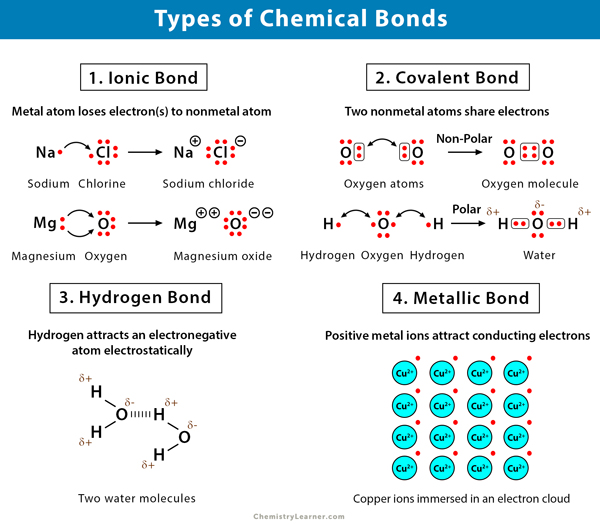
Ionic bonds are formed when a metal atom transfers one or more electrons to a nonmetal atom, resulting in the creation of oppositely charged ions that attract each other. This process typically occurs between elements with large differences in electronegativity.
Definition: An ionic bond is the electrostatic attraction between positively charged cations and negatively charged anions.
Formation: Metal atoms lose electrons to become cations, while nonmetal atoms gain electrons to become anions.
Example: Sodium (Na) transfers an electron to chlorine (Cl), forming sodium chloride (NaCl).
Example: Magnesium (Mg) transfers electrons to oxygen (O), forming magnesium oxide (MgO).
Covalent Bond
Covalent bonds occur when two nonmetal atoms share pairs of electrons. The shared electrons allow each atom to achieve a stable electron configuration. Covalent bonds can be non-polar or polar depending on the difference in electronegativity between the atoms involved.
Definition: A covalent bond is a chemical bond formed by the sharing of electron pairs between atoms.
Non-Polar Covalent Bond: Electrons are shared equally between atoms (e.g., O2 molecule).
Polar Covalent Bond: Electrons are shared unequally, resulting in partial charges (e.g., H2O molecule).
Example: Oxygen atoms share electrons to form O2.
Example: Hydrogen and oxygen share electrons to form water (H2O).
Hydrogen Bond
Hydrogen bonds are a type of intermolecular force that occurs when a hydrogen atom covalently bonded to a highly electronegative atom (such as oxygen, nitrogen, or fluorine) is attracted to another electronegative atom in a nearby molecule. Hydrogen bonds are crucial in determining the properties of water and biological molecules.
Definition: A hydrogen bond is an electrostatic attraction between a hydrogen atom (bonded to O, N, or F) and another electronegative atom.
Example: Two water molecules are held together by hydrogen bonds.
Importance: Hydrogen bonds contribute to the high boiling point of water and the structure of DNA.
Metallic Bond
Metallic bonds are found in metals, where positive metal ions are surrounded by a 'sea' of delocalized electrons. These electrons are free to move throughout the structure, giving metals their characteristic properties such as electrical conductivity and malleability.
Definition: A metallic bond is the attraction between positive metal ions and delocalized electrons.
Formation: Metal atoms release electrons, which move freely among the ions.
Example: Copper ions immersed in an electron cloud.
Properties: Metals are good conductors of electricity and heat, and are malleable and ductile.
Comparison Table: Types of Chemical Bonds
Bond Type | Participants | Bonding Mechanism | Example |
|---|---|---|---|
Ionic | Metal + Nonmetal | Electron transfer | NaCl, MgO |
Covalent | Nonmetal + Nonmetal | Electron sharing | O2, H2O |
Hydrogen | Hydrogen + Electronegative atom | Electrostatic attraction | H2O (between molecules) |
Metallic | Metal atoms | Delocalized electrons | Cu, Fe |
