 Back
BackUnit 1 FRQ Practice – General Chemistry Study Guidance
Study Guide - Smart Notes
 Tailored notes based on your materials, expanded with key definitions, examples, and context.
Q1a. Calculate the grams of water lost during heating.
Background
Topic: Empirical Formula of Hydrates
This question tests your ability to use mass measurements to determine the amount of water lost from a hydrate during heating.
Key Terms and Formulas:
Hydrate: A compound that contains water molecules within its crystal structure.
Anhydrous: The compound after water has been removed.
Mass lost = Mass before heating - Mass after heating
Step-by-Step Guidance
Identify the mass of the crucible plus hydrate before heating ().
Identify the mass of the crucible plus anhydrous salt after heating ().
Subtract the mass after heating from the mass before heating to find the mass of water lost.
Set up the calculation: .
Try solving on your own before revealing the answer!
Final Answer: 1.36 g
The mass difference represents the water driven off during heating.
Q1b. Calculate the moles of water lost during heating.
Background
Topic: Mole Calculations
This question tests your ability to convert mass to moles using the molar mass of water.
Key Terms and Formulas:
Mole: A unit representing particles.
Molar mass of water ():
Step-by-Step Guidance
Use the mass of water lost from part (a).
Recall the molar mass of water ().
Set up the calculation: .
Try solving on your own before revealing the answer!
Final Answer: 0.0755 mol
This gives the number of moles of water lost during heating.
Q1c. Determine the empirical formula for the hydrate.
Background
Topic: Empirical Formula Determination
This question tests your ability to use mole ratios to determine the empirical formula of a hydrate.
Key Terms and Formulas:
Empirical formula: The simplest whole-number ratio of elements in a compound.
Hydrate formula:
Moles of anhydrous salt:
Step-by-Step Guidance
Find the mass of anhydrous CuSO by subtracting the mass of the empty crucible from the mass after heating.
Calculate moles of CuSO using its molar mass ().
Use the moles of water from part (b).
Set up the ratio: .
Round the ratio to the nearest whole number to find in .
Try solving on your own before revealing the answer!
Final Answer: CuSO4·5H2O
The ratio of moles of water to moles of CuSO4 is approximately 5:1, so the empirical formula is CuSO4·5H2O.
Q1d. During another trial, the student notices some of the hydrate splattered out of the crucible during heating. Will the number of moles of water calculated for this trial be greater than, less than, or equal to the number calculated in part (b)? Justify your answer.
Background
Topic: Experimental Error and Data Interpretation
This question tests your understanding of how experimental errors affect calculated values.
Key Terms:
Experimental error: Mistakes or accidents that affect measurements.
Hydrate splattering: Loss of sample during heating.
Step-by-Step Guidance
Consider what happens when hydrate splatters: both water and CuSO are lost.
Think about how this affects the mass difference used to calculate water lost.
Reason whether the calculated mass of water lost will be artificially low or high.
Connect this to the calculation of moles of water.
Try solving on your own before revealing the answer!
Final Answer: Less than
If hydrate splatters, some water and salt are lost, so the mass difference will be smaller than it should be. This means the calculated moles of water will be less than the true value.
Q2a. Write the complete ground-state electron configuration of the Kr atom.
Background
Topic: Electron Configuration
This question tests your ability to write the full electron configuration for a noble gas atom.
Key Terms:
Ground-state: The lowest energy arrangement of electrons.
Electron configuration: The distribution of electrons among atomic orbitals.
Step-by-Step Guidance
Recall the atomic number of Kr (krypton), which is 36.
Fill orbitals in order of increasing energy: 1s, 2s, 2p, 3s, 3p, 4s, 3d, 4p.
Write out the electron configuration, making sure the total adds up to 36 electrons.
Try solving on your own before revealing the answer!
Final Answer: 1s2 2s2 2p6 3s2 3p6 4s2 3d10 4p6
This configuration fills all orbitals up to krypton, atomic number 36.
Q2b. The Rb+ ion has the same electron configuration as the neutral Kr atom. Which has the larger radius, the Rb+ ion or the Kr atom? Justify your answer in terms of Coulomb’s law.
Background
Topic: Ionic vs Atomic Radius, Coulomb’s Law
This question tests your understanding of how charge and electron configuration affect atomic and ionic radii.
Key Terms and Formulas:
Coulomb’s Law:
Effective nuclear charge: The net positive charge experienced by electrons.
Step-by-Step Guidance
Recognize that both Rb+ and Kr have the same electron configuration.
Compare the number of protons in Rb+ (37) and Kr (36).
Consider how the greater nuclear charge in Rb+ affects the attraction to electrons.
Use Coulomb’s law to reason about the effect on radius.
Try solving on your own before revealing the answer!
Final Answer: Kr has the larger radius
Rb+ has more protons, so its electrons are pulled closer, making its radius smaller than Kr.
Q2c(i). Using the values in the table, calculate the average atomic mass, in amu, of Rb in the sample.
Background
Topic: Average Atomic Mass Calculation
This question tests your ability to calculate weighted averages using isotopic abundances.
Key Terms and Formulas:
Isotope: Atoms of the same element with different numbers of neutrons.
Average atomic mass:
Step-by-Step Guidance
Convert percent abundances to decimals.
Multiply each isotope’s mass by its fractional abundance.
Add the products to get the average atomic mass.
Try solving on your own before revealing the answer!
Final Answer: 85.2 amu
Average atomic mass = (0.325 × 83) + (0.508 × 85) + (0.167 × 87) = 85.2 amu
Q2c(ii). Over time, how will the average atomic mass of the remaining sample compare to the value calculated in part c(i)?
Background
Topic: Radioactive Decay and Isotopic Abundance
This question tests your understanding of how radioactive decay affects average atomic mass.
Key Terms:
Radioactive decay: The process by which unstable isotopes lose mass and change identity.
Isotopic abundance: The percentage of each isotope in a sample.
Step-by-Step Guidance
Recognize that Rb-83 decays and leaves the sample as Kr-83.
Consider how the loss of the lighter isotope (Rb-83) affects the average mass.
Reason whether the average atomic mass will increase or decrease.
Try solving on your own before revealing the answer!
Final Answer: The average atomic mass will increase
As the lighter Rb-83 isotope decays and leaves, the average mass of the remaining sample increases.
Q3a. Draw a line on the graph to show the mass of the missing isotope and its percent abundance.
Background
Topic: Mass Spectrometry and Isotopic Abundance
This question tests your ability to interpret and complete a mass spectrum for magnesium isotopes.
Key Terms:
Mass spectrum: A graph showing the abundance of isotopes versus mass number.
Isotopic abundance: The percentage of each isotope present.
Step-by-Step Guidance
Identify the missing isotope (Mg-24) based on the mass numbers shown.
Estimate the percent abundance by subtracting the abundances of Mg-25 and Mg-26 from 100%.
Draw a line at mass number 24 with the calculated percent abundance.
Try solving on your own before revealing the answer!
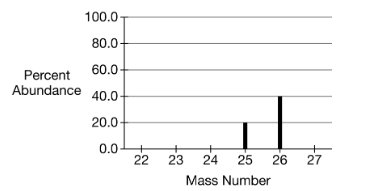
Final Answer: Mg-24 line at 50% abundance
The missing isotope is Mg-24, and its percent abundance is 50% (100% - 20% - 30%). Draw a line at mass number 24 at the 50% mark.
Q3b. Use the completed mass spectrum to calculate the average atomic mass of Mg on the other planet.
Background
Topic: Average Atomic Mass Calculation
This question tests your ability to use isotopic abundances to calculate average atomic mass.
Key Terms and Formulas:
Average atomic mass:
Step-by-Step Guidance
Convert percent abundances to decimals for Mg-24, Mg-25, and Mg-26.
Multiply each isotope’s mass by its fractional abundance.
Add the products to get the average atomic mass.
Try solving on your own before revealing the answer!
Final Answer: 24.8 amu
Average atomic mass = (0.50 × 24) + (0.20 × 25) + (0.30 × 26) = 24.8 amu
Q3c. If a similar experiment is conducted to determine the first ionization energy of magnesium in the rock sample from another planet, will it be greater, less than, or equal to the first ionization energy of magnesium found on Earth? Explain your reasoning.
Background
Topic: Ionization Energy and Isotopic Effects
This question tests your understanding of how isotopic composition affects ionization energy.
Key Terms:
Ionization energy: The energy required to remove an electron from an atom.
Isotopic composition: The distribution of isotopes in a sample.
Step-by-Step Guidance
Consider whether isotopic mass affects electron binding energy.
Recall that ionization energy is mainly determined by electron configuration, not isotopic mass.
Reason whether the ionization energy will change based on the isotopic distribution.
Try solving on your own before revealing the answer!
Final Answer: Equal
Ionization energy depends on electron configuration, not isotopic mass, so it will be equal to the value found on Earth.
Q3d. Predict the identity of the unknown element using the table of successive ionization energies for Mg and the unknown element.
Background
Topic: Successive Ionization Energies
This question tests your ability to use patterns in ionization energies to identify elements.
Key Terms:
Successive ionization energies: The energy required to remove each electron in sequence.
Large jump: Indicates removal of a core electron.
Step-by-Step Guidance
Compare the pattern of ionization energies for Mg and the unknown element.
Identify where the large jump occurs in the unknown element’s data.
Relate the jump to the number of valence electrons.
Use periodic table knowledge to predict the element’s identity.
Try solving on your own before revealing the answer!
Final Answer: Sodium (Na)
The large jump after the first ionization energy indicates one valence electron, characteristic of sodium.
Q4a. Based on the photoelectron spectrum, identify the unknown element and write its electron configuration.
Background
Topic: Photoelectron Spectroscopy and Electron Configuration
This question tests your ability to interpret a photoelectron spectrum to identify an element and its electron configuration.
Key Terms:
Photoelectron spectrum: Shows the binding energies of electrons in different orbitals.
Electron configuration: The arrangement of electrons in orbitals.
Step-by-Step Guidance
Count the number of peaks and their relative intensities in the spectrum.
Match the peaks to the expected orbitals for elements in the periodic table.
Use the binding energy values to help identify the element.
Write the electron configuration based on the number of electrons and orbitals.
Try solving on your own before revealing the answer!
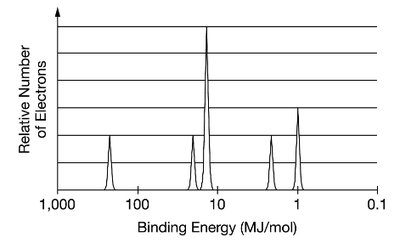
Final Answer: Magnesium (Mg), 1s2 2s2 2p6 3s2
The spectrum matches magnesium, which has 12 electrons and the configuration 1s2 2s2 2p6 3s2.
Q4b. Consider the element in the periodic table that is directly to the right of the element identified in part (a). Would the peak of this element appear to the left of, the right of, or in the same position as the peak of the element in part (a)? Explain your reasoning.
Background
Topic: Photoelectron Spectroscopy and Periodic Trends
This question tests your understanding of how binding energy changes across a period.
Key Terms:
Binding energy: The energy required to remove an electron from an atom.
Periodic trend: Binding energy increases across a period.
Step-by-Step Guidance
Identify the element to the right of magnesium (aluminum).
Recall that binding energy increases as nuclear charge increases.
Reason whether the peak will shift left (higher energy) or right (lower energy).
Try solving on your own before revealing the answer!
Final Answer: The peak will appear to the left
As nuclear charge increases, binding energy increases, so the peak shifts to the left (higher energy).
Q5a. Draw an X above the peak that corresponds to the orbital with electrons that are, on average, closest to the nucleus. Justify your answer in terms of Coulomb’s law.
Background
Topic: Photoelectron Spectroscopy and Coulomb’s Law
This question tests your ability to identify core electrons in a photoelectron spectrum and explain their binding energy.
Key Terms:
Core electrons: Electrons in the innermost orbitals (1s).
Coulomb’s law:
Binding energy: Highest for electrons closest to the nucleus.
Step-by-Step Guidance
Identify the peak with the highest binding energy (furthest left on the spectrum).
Recall that this peak corresponds to the 1s orbital.
Justify using Coulomb’s law: electrons closer to the nucleus experience greater attraction.
Try solving on your own before revealing the answer!
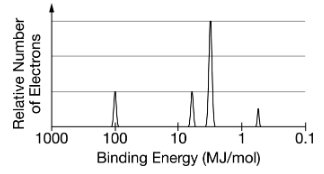
Final Answer: X above the leftmost peak
The leftmost peak corresponds to the 1s electrons, which are closest to the nucleus and have the highest binding energy due to Coulomb’s law.
Q5b. Based on the spectrum, write the complete electron configuration of the element.
Background
Topic: Electron Configuration from Photoelectron Spectrum
This question tests your ability to deduce electron configuration from the number and intensity of peaks.
Key Terms:
Electron configuration: The arrangement of electrons in orbitals.
Photoelectron spectrum: Shows the number of electrons in each orbital.
Step-by-Step Guidance
Count the number of peaks and their relative heights.
Assign each peak to an orbital (1s, 2s, 2p, 3s, etc.).
Write the electron configuration based on the number of electrons in each orbital.
Try solving on your own before revealing the answer!
Final Answer: 1s2 2s2 2p6 3s1
The spectrum matches sodium, which has 11 electrons and the configuration 1s2 2s2 2p6 3s1.
Q5c. On the graph, draw the peak(s) corresponding to the valence electrons of the element that has one more proton in its nucleus than the unknown element has.
Background
Topic: Valence Electrons and Photoelectron Spectroscopy
This question tests your ability to predict changes in the photoelectron spectrum for an element with one more proton.
Key Terms:
Valence electrons: Electrons in the outermost shell.
Photoelectron spectrum: Shows binding energies of electrons.
Step-by-Step Guidance
Identify the element with one more proton (magnesium).
Recall magnesium has two valence electrons in the 3s orbital.
Predict the peak for the 3s electrons will be higher (more electrons) and possibly shifted left (higher binding energy).
Try solving on your own before revealing the answer!
Final Answer: Draw a higher peak at the 3s binding energy
For magnesium, the 3s peak will be taller (representing two electrons) and may shift left due to higher binding energy.
