 Back
BackUnit 2: Chemical Kinetics, Equilibrium, and Acids/Bases – Mini-Textbook Study Guide
Study Guide - Smart Notes
 Tailored notes based on your materials, expanded with key definitions, examples, and context.
Chemical Kinetics
Introduction to Kinetics
Chemical kinetics is the study of the rates at which chemical reactions occur and the factors that affect these rates. Understanding kinetics allows chemists to predict how fast reactions proceed and how to control them.
Reaction Rate: The change in concentration of reactants or products per unit time.
Factors Affecting Rate: Reactant concentration, temperature, surface area (for solids), and catalysts.
Goal: To understand reactions at the molecular level and predict their behavior.
Measuring Reaction Rates
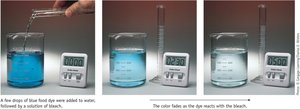
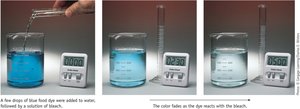
Reaction rates can be measured by monitoring the disappearance of reactants or the appearance of products over time. For example, the fading of a dye in solution as it reacts with bleach demonstrates the decrease in reactant concentration.
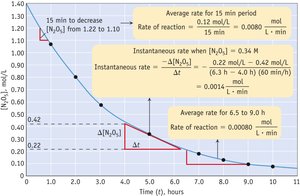
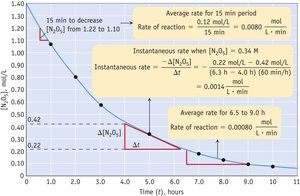
Average Rate: Change in concentration over a specified time interval.
Instantaneous Rate: Rate at a specific moment, determined by the slope of the concentration vs. time curve.
Initial Rate: Rate at the very beginning of the reaction.
Graphical Analysis of Rate
Reaction rates are often visualized using concentration vs. time graphs. The slope of these graphs indicates the rate of reaction, which typically decreases as reactants are consumed.
Key Point: The steeper the slope, the faster the reaction.
Example: The rate of dye disappearance decreases over time as shown in the graph.
Types of Reaction Rates
Initial Rate: Measured at the start of the reaction.
Average Rate: Measured over a time interval.
Instantaneous Rate: Measured at a specific time point.
Factors Affecting Reaction Rate
Several factors influence how quickly a reaction proceeds:
Concentration: Higher concentration increases collision frequency.
Temperature: Higher temperature increases kinetic energy and collision frequency.
Surface Area: Greater surface area (for solids) increases exposure to reactants.
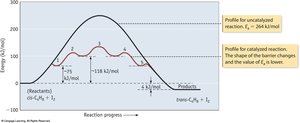
Catalysis: Catalysts lower activation energy, speeding up reactions.
Rate Laws and Reaction Order
The rate law expresses the relationship between the rate of a reaction and the concentrations of reactants. The reaction order indicates how the rate depends on each reactant's concentration.
General Rate Law:
Order: The exponent for each reactant; overall order is the sum of exponents.
Units for Rate Constant: Depend on reaction order (e.g., for second order: ).
Method of Initial Rates
This experimental method determines the rate law by varying the concentration of one reactant while keeping others constant and measuring the initial rate.
Example: For the reaction , compare rates from different experiments to deduce reaction order.
Integrated Rate Laws
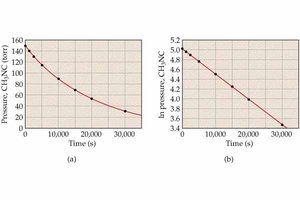
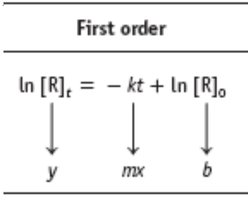
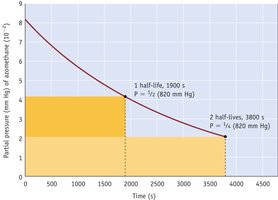
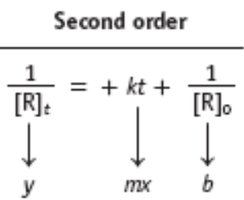
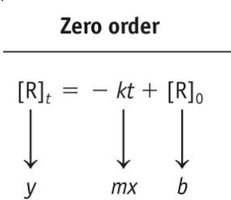
Integrated rate laws relate reactant concentration to time for different reaction orders. They allow calculation of concentrations at any time during the reaction.
First Order:
Second Order:
Zero Order:
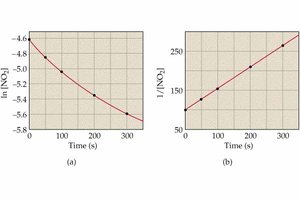
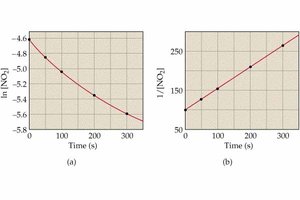
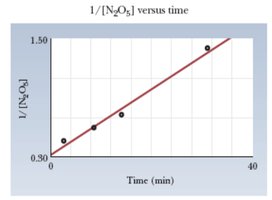
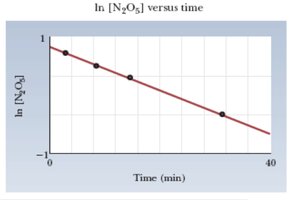
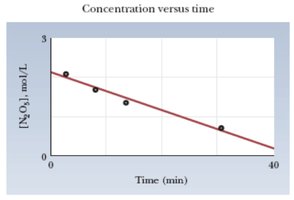
Graphical Determination of Order
To determine reaction order, plot different functions of concentration vs. time:
Zero Order: vs. time (linear)
First Order: vs. time (linear)
Second Order: vs. time (linear)
Collision Theory
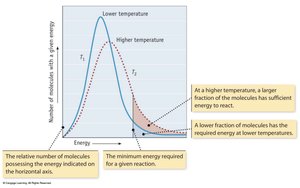
Collision theory explains that molecules must collide with proper orientation and sufficient energy to react. Increasing concentration or temperature increases collision frequency and energy, thus increasing reaction rate.
Effective Collision: Proper orientation and energy.
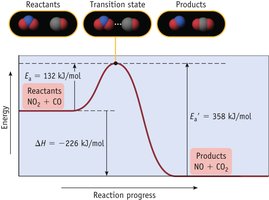
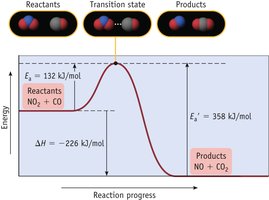
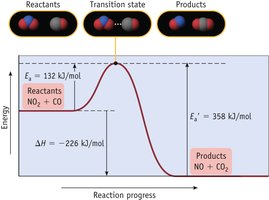
Activation Energy (Ea): Minimum energy required for reaction.
Effect of Temperature and Catalysts
Temperature increases the fraction of molecules with enough energy to overcome the activation barrier. Catalysts provide an alternative pathway with lower activation energy.
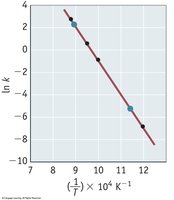
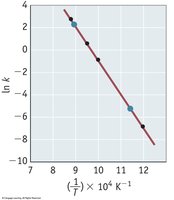
Arrhenius Equation:
Graphical Analysis: Plotting vs. yields a straight line.
Catalysis
Catalysts speed up reactions by lowering activation energy. They are not consumed in the reaction and can be homogeneous (same phase as reactants) or heterogeneous (different phase).
Enzymes: Biological catalysts, often proteins, that greatly increase reaction rates.
Reaction Mechanisms
Reaction mechanisms describe the stepwise sequence of elementary reactions leading from reactants to products. The slowest step is the rate-determining step.
Molecularity: Number of molecules involved in an elementary step (unimolecular, bimolecular).
Intermediates: Species produced in one step and consumed in another.
Chemical Equilibrium
Dynamic Equilibrium
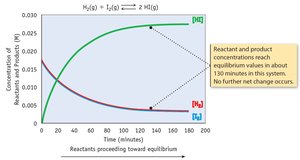
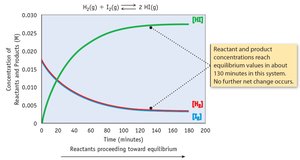
Chemical equilibrium occurs when the rates of the forward and reverse reactions are equal, and concentrations of reactants and products remain constant.
Equilibrium Constant (K): Ratio of product concentrations to reactant concentrations at equilibrium.
Kc: Based on concentrations; Kp: Based on partial pressures.
Writing Equilibrium Expressions
General Form: for
Rules: Solids and pure liquids are omitted; only gases and solutes are included.
Relating Kc and Kp
Relationship: , where is the change in moles of gas.
Interpreting K Values
K >> 1: Product-favored equilibrium.
K << 1: Reactant-favored equilibrium.
K \approx 1: Comparable amounts of reactants and products.
Reaction Quotient (Q)
The reaction quotient, Q, is calculated like K but with current concentrations. Comparing Q to K predicts the direction of reaction:
Q < K: Reaction proceeds forward.
Q > K: Reaction proceeds in reverse.
Q = K: System is at equilibrium.
ICE Tables
ICE tables (Initial, Change, Equilibrium) organize data for equilibrium calculations.
Steps: Fill in initial concentrations, changes (using x), and equilibrium concentrations.
Example: Used to solve for equilibrium concentrations and K values.
Manipulating Equilibrium Constants
Scaling Equation: If coefficients are multiplied by n, .
Reversing Equation: .
Adding Equations: Multiply corresponding K values.
Le Chatelier’s Principle
Le Chatelier’s Principle states that a system at equilibrium will adjust to counteract changes in concentration, temperature, or pressure.
Add Reactant: Shifts equilibrium right (toward products).
Add Product: Shifts equilibrium left (toward reactants).
Remove Reactant: Shifts equilibrium left.
Remove Product: Shifts equilibrium right.
Change Temperature: Alters K; treat heat as reactant (endothermic) or product (exothermic).
Change Pressure/Volume: Affects gas-phase equilibria; shifts toward fewer or more gas molecules.
Add Catalyst: No effect on equilibrium position; speeds up attainment of equilibrium.
Acids and Bases
Nature and Definitions of Acids and Bases
Acids and bases are classified by their behavior in water and their ability to donate or accept protons.
Arrhenius Acid: Produces H+ in water.
Arrhenius Base: Produces OH- in water.
Brønsted-Lowry Acid: Proton donor.
Brønsted-Lowry Base: Proton acceptor.
Amphiprotic: Can act as acid or base (e.g., H2O).
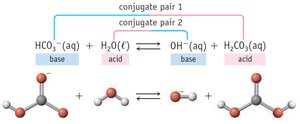
Conjugate Acid-Base Pairs
Every acid-base reaction involves two conjugate pairs, differing by one proton.
Conjugate Acid: Species with an extra H+.
Conjugate Base: Species missing an H+.
Acid and Base Strength
Strong Acids: Completely ionize in water (e.g., HCl, HNO3).
Weak Acids: Partially ionize; equilibrium must be considered.
Strong Bases: Completely ionize (e.g., NaOH).
Weak Bases: Partially ionize (e.g., NH3).
Acid and Base Equilibrium Constants
Ka: Acid ionization constant; larger Ka means stronger acid.
Kb: Base ionization constant; larger Kb means stronger base.
Relationship: (water ionization constant).
pKa: ; lower pKa means stronger acid.
pKb: .
Autoionization of Water and pH
Autoionization:
Kw: at 25°C
pH:
pOH:
Relationship:
Acid-Base Properties of Salts
Salts can affect solution pH depending on the acid/base properties of their ions.
Conjugate base of strong acid: No effect (e.g., Cl-).
Conjugate base of weak acid: Basic effect (e.g., CH3COO-).
Conjugate acid of weak base: Acidic effect (e.g., NH4+).
Group IA/IIA cations: No effect.
Hydrated transition metal ions: Acidic effect.
Polyprotic Acids
Polyprotic acids can donate more than one proton, with each successive ionization having a smaller Ka value.
Example: H3PO4 has three ionization steps, each with a different Ka.
Lewis Acids and Bases
Lewis Acid: Electron pair acceptor.
Lewis Base: Electron pair donor.
Summary Table: Reaction Orders and Integrated Rate Laws
Order | Integrated Rate Law | Graph for Linear Fit |
|---|---|---|
Zero | vs. time | |
First | vs. time | |
Second | vs. time |
Additional info: This guide covers core concepts from Chapters 14, 15, and 16, including chemical kinetics, equilibrium, and acids/bases, as outlined in the provided syllabus. All images included directly reinforce the explanations and are relevant to the adjacent content.
