 Back
BackUnit 2 General Chemistry Review – Step-by-Step Study Guidance
Study Guide - Smart Notes
 Tailored notes based on your materials, expanded with key definitions, examples, and context.
Q1. Do ions have an unequal number of protons and electrons?
Background
Topic: Atomic Structure & Ions
This question tests your understanding of what defines an ion and how ions differ from neutral atoms in terms of subatomic particles.
Key Terms:
Ion: An atom or molecule with a net electric charge due to the loss or gain of electrons.
Proton: Positively charged subatomic particle found in the nucleus.
Electron: Negatively charged subatomic particle found outside the nucleus.
Step-by-Step Guidance
Recall that a neutral atom has equal numbers of protons and electrons.
Consider what happens when an atom gains or loses electrons (but not protons).
Think about how the charge of an ion is determined by the difference between the number of protons and electrons.
Try solving on your own before revealing the answer!
Q2. Do protons and neutrons have approximately the same mass?
Background
Topic: Subatomic Particles
This question is about the relative masses of protons, neutrons, and electrons.
Key Terms:
Proton: Mass ≈ 1 atomic mass unit (amu)
Neutron: Mass ≈ 1 amu (slightly more than a proton)
Electron: Mass ≈ 1/1836 amu (much lighter)
Step-by-Step Guidance
Recall the approximate masses of protons and neutrons in atomic mass units.
Compare the values to determine if they are similar or significantly different.
Consider why this similarity or difference is important for atomic mass calculations.
Try solving on your own before revealing the answer!
Q3. Do electrons experience attraction toward neutrons?
Background
Topic: Atomic Structure & Forces
This question tests your understanding of the forces acting between subatomic particles in an atom.
Key Terms:
Electrostatic (Coulombic) Attraction: Attraction between particles of opposite charge.
Electron: Negatively charged particle.
Neutron: Neutral particle (no charge).
Step-by-Step Guidance
Recall the charges of electrons and neutrons.
Think about what types of particles attract or repel each other based on charge.
Consider whether a neutral particle can attract or repel a charged particle via electrostatic forces.
Try solving on your own before revealing the answer!
Q4. Does an element always have an equal number of neutrons and protons?
Background
Topic: Atomic Structure & Isotopes
This question is about the relationship between protons, neutrons, and the identity of an element.
Key Terms:
Atomic Number (Z): Number of protons in the nucleus (defines the element).
Neutron Number (N): Number of neutrons in the nucleus.
Isotope: Atoms of the same element with different numbers of neutrons.
Step-by-Step Guidance
Recall that the atomic number is fixed for each element, but the number of neutrons can vary.
Think about examples of elements with more or fewer neutrons than protons (isotopes).
Consider whether all atoms of an element must have the same number of neutrons as protons.
Try solving on your own before revealing the answer!
Q5. Are isotopes atoms of the same element that have different numbers of neutrons?
Background
Topic: Isotopes
This question tests your understanding of what defines isotopes and how they differ from each other.
Key Terms:
Isotope: Atoms of the same element (same number of protons) with different numbers of neutrons.
Mass Number (A): Total number of protons and neutrons in the nucleus.
Step-by-Step Guidance
Recall the definition of an isotope.
Think about how isotopes of an element are similar and how they differ.
Consider examples such as carbon-12 and carbon-14.
Try solving on your own before revealing the answer!
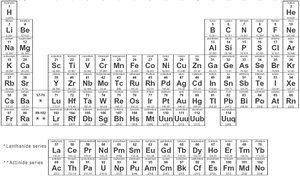
Q6. Identify whether each element is a metal or nonmetal. Further, classify each as a halogen, noble gas, alkali metal, alkaline earth metal, or transition metal.
Background
Topic: Periodic Table & Element Classification
This question tests your ability to use the periodic table to classify elements by their group and type.
Key Terms:
Metal: Elements that are typically shiny, conductive, and malleable.
Nonmetal: Elements that are typically not shiny, not conductive, and brittle.
Halogen: Group 17 elements.
Noble Gas: Group 18 elements.
Alkali Metal: Group 1 elements (except hydrogen).
Alkaline Earth Metal: Group 2 elements.
Transition Metal: Elements in groups 3–12.
Step-by-Step Guidance
Locate each element (Be, Rb, Cl, Zr, Ar) on the periodic table.
Determine if the element is a metal or nonmetal based on its position.
Further classify each element into one of the specified groups (halogen, noble gas, etc.) using the periodic table.
Remember that ions (e.g., Rb-, Cl-) are classified based on their neutral atom's group.
Try solving on your own before revealing the answer!
Q7. For each element below, identify the number of protons, neutrons, and electrons: 24Mg, 59Co, 58Co, Fe2+, Se2-
Background
Topic: Atomic Structure & Isotopes
This question tests your ability to determine the number of subatomic particles in atoms and ions using atomic numbers and mass numbers.
Key Terms and Formulas:
Atomic Number (Z): Number of protons.
Mass Number (A): Number of protons + neutrons.
Number of Neutrons:
Number of Electrons: For neutral atoms, equals protons; for ions, adjust for charge.
Step-by-Step Guidance
For each isotope or ion, identify the atomic number (Z) from the periodic table.
Calculate the number of protons (equals Z).
Calculate the number of neutrons using .
Determine the number of electrons: for ions, add or subtract electrons based on the charge.
Try solving on your own before revealing the answer!
Q8. In question 7, which were isotopes?
Background
Topic: Isotopes
This question asks you to identify which of the species listed in Q7 are isotopes of the same element.
Key Terms:
Isotopes: Atoms of the same element (same number of protons) with different numbers of neutrons (different mass numbers).
Step-by-Step Guidance
Review the list from Q7 and identify which have the same atomic number but different mass numbers.
Compare the protons and neutrons for each to determine which are isotopes.
Try solving on your own before revealing the answer!
Q9. Write the atomic symbol (A/Z X) for each of the following:
a) Protons = 27; neutrons = 31
b) Atomic number = 53; neutrons = 79
Background
Topic: Atomic Notation
This question tests your ability to write the atomic symbol for an element given its number of protons and neutrons.
Key Terms and Formula:
Atomic Symbol:
Mass Number (A): Protons + Neutrons
Atomic Number (Z): Number of protons
X: Element symbol from the periodic table
Step-by-Step Guidance
Calculate the mass number by adding protons and neutrons.
Identify the element symbol using the atomic number from the periodic table.
Write the atomic symbol in the form .
Try solving on your own before revealing the answer!
