 Back
BackUnit 7 Study Guide – Thermodynamics, Entropy, Electrochemistry, and Equilibrium
Study Guide - Smart Notes
 Tailored notes based on your materials, expanded with key definitions, examples, and context.
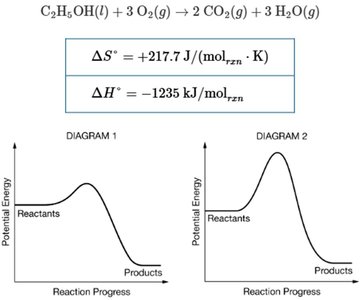
Q1. The combustion of C2H5OH is represented by the equation and the standard entropy and enthalpy changes for the reaction are provided. When the reactants are combined at 25°C, essentially no CO2 (g) or H2O (g) is produced after a few hours. Which of the diagrams above could help explain the low yield of the reaction under these conditions and why?
Background
Topic: Thermodynamics and Kinetics
This question tests your understanding of the difference between thermodynamic favorability (ΔG, ΔH, ΔS) and reaction kinetics (activation energy, reaction rate). Even if a reaction is thermodynamically favorable, it may not proceed quickly if the activation energy is high.
Key Terms and Formulas:
ΔH°: Standard enthalpy change
ΔS°: Standard entropy change
ΔG°: Standard free energy change,
Activation energy: The energy barrier that must be overcome for a reaction to proceed
Step-by-Step Guidance
Examine the values for ΔH° and ΔS°: (exothermic), (increase in entropy).
Calculate the sign of ΔG° at 25°C using . Both terms favor spontaneity, so the reaction is thermodynamically favorable.
Analyze the diagrams: Diagram 1 and Diagram 2 show potential energy profiles. Diagram 2 has a much higher activation energy barrier than Diagram 1.
Consider the effect of activation energy: A high activation energy means the reaction proceeds very slowly, even if it is thermodynamically favorable.
Try solving on your own before revealing the answer!
Final Answer: Diagram 2, because it represents a reaction with a high activation energy barrier for molecules to overcome and a very slow reaction rate, even if it is thermodynamically favorable with ΔG° < 0.
Diagram 2 explains why the reaction has a low yield after a few hours: the high activation energy slows the reaction rate, so little product forms despite thermodynamic favorability.
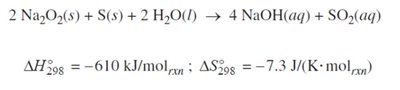
Q4. When water is added to a mixture of Na2O2 (s) and S(s), a redox reaction occurs. Which of the following statements about the thermodynamic favorability of the reaction at 298 K is correct?
Background
Topic: Thermodynamics – Enthalpy and Entropy
This question tests your ability to interpret ΔH° and ΔS° values to determine if a reaction is thermodynamically favorable at a given temperature.
Key Terms and Formulas:
ΔH°: Standard enthalpy change ()
ΔS°: Standard entropy change ()
ΔG°: Standard free energy change,
Step-by-Step Guidance
Identify the signs: ΔH° is negative (exothermic), ΔS° is negative (entropy decreases).
Recall that a negative ΔH° favors spontaneity, while a negative ΔS° opposes it.
Use the formula to predict favorability at 298 K.
At low temperatures, the enthalpy term dominates; at high temperatures, the entropy term becomes more important.
Try solving on your own before revealing the answer!
Final Answer: It is thermodynamically favorable at 298 K.
The large negative ΔH° outweighs the small negative ΔS°, so ΔG° is negative and the reaction is spontaneous at room temperature.
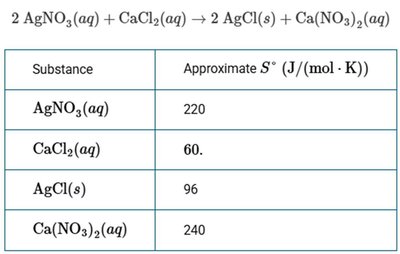
Q5. The reaction between AgNO3 and CaCl2 is represented in the equation, and the table provides the approximate S° values for the reactants and products. Which of the following is the approximate ΔS° for the reaction?
Background
Topic: Entropy Change in Chemical Reactions
This question tests your ability to calculate the change in entropy (ΔS°) for a reaction using standard entropy values for each substance.
Key Terms and Formulas:
ΔS°: Standard entropy change
Formula:
Step-by-Step Guidance
Write the balanced equation:
List the S° values for each substance from the table.
Calculate the total S° for products:
Calculate the total S° for reactants:
Set up the formula:
Try solving on your own before revealing the answer!
Final Answer: -68 J/mol·K
Plugging in the values: J/mol·K. The reaction results in a decrease in entropy.
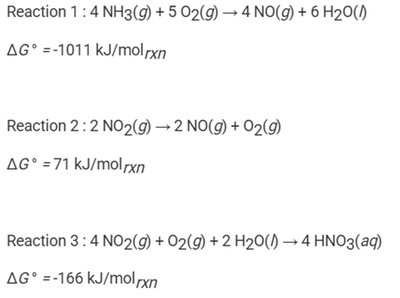
Q6. Based on the values for the three reactions represented, what is the value of ΔG° for the reaction: 4 NH3 (g) + 8 O2 (g) → 4 HNO3 (aq) + 4 H2O (l)?
Background
Topic: Thermodynamics – Standard Free Energy Change
This question tests your ability to use the values of ΔG° for related reactions to calculate ΔG° for a target reaction, often using Hess's Law.
Key Terms and Formulas:
ΔG°: Standard free energy change
Hess's Law: The sum of ΔG° for individual reactions can be used to find ΔG° for a combined reaction.
Step-by-Step Guidance
Write out the three given reactions and their ΔG° values.
Determine how to combine the reactions (add, subtract, multiply) to obtain the target reaction.
Adjust the coefficients as needed, making sure to multiply ΔG° values accordingly.
Sum the adjusted ΔG° values to set up the calculation for the target reaction.
Try solving on your own before revealing the answer!
Final Answer: -1319 kJ/mol
By combining the reactions using Hess's Law and summing the ΔG° values, you find the standard free energy change for the target reaction.
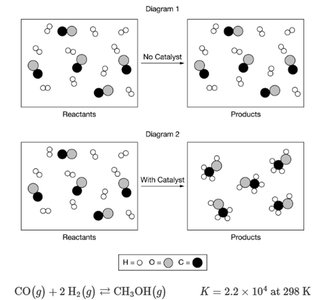
Q7. A stoichiometric mixture of CO (g) and H2 (g) was allowed to react in two different 2.0 L rigid containers at a constant temperature of 298 K. The reaction is represented by the equation. Diagram 1 represents the uncatalyzed reaction and diagram 2 represents the catalyzed reaction one hour after the reactants were mixed. Which of the following correctly explains the experimental results represented in the particle diagrams?
Background
Topic: Kinetics and Thermodynamics
This question tests your understanding of how catalysts affect reaction rates and the relationship between thermodynamic favorability and kinetics.
Key Terms and Formulas:
Catalyst: A substance that increases the rate of a reaction by lowering the activation energy, without affecting ΔG°.
ΔG°: Standard free energy change
K: Equilibrium constant
Step-by-Step Guidance
Examine the equilibrium constant (K = 2.2 × 10⁴): This indicates the reaction is thermodynamically favorable (ΔG° < 0).
Compare the diagrams: Diagram 1 (no catalyst) shows little product formation; Diagram 2 (with catalyst) shows significant product formation.
Recall that a catalyst lowers the activation energy, allowing the reaction to proceed faster.
Understand that the catalyst does not change ΔG° or K, only the rate at which equilibrium is reached.
Try solving on your own before revealing the answer!
Final Answer: Although the reaction is thermodynamically favorable because ΔG° < 0 based on the value of K, only the catalyzed reaction could proceed in one hour because it has a lower activation-energy pathway.
The catalyst enables the reaction to reach equilibrium faster by lowering the activation energy, not by changing the thermodynamic favorability.
