 Back
BackUnit Conversions & The Metric System: Study Notes
Study Guide - Smart Notes
 Tailored notes based on your materials, expanded with key definitions, examples, and context.
Unit Conversions & The Metric System
Introduction to Unit Conversions
Unit conversions are a fundamental skill in general chemistry, allowing students to translate measurements between different units within the metric system. Understanding how to use conversion factors and metric prefixes is essential for accurate scientific calculations.
Base Unit: The standard unit for a quantity (e.g., meter (m), gram (g), liter (L)).
Derived Unit: Units that are multiples or fractions of the base unit, indicated by prefixes (e.g., kilogram (kg), milliliter (mL)).
Conversion Factor: A ratio used to convert from one unit to another, based on the relationship between units.
Metric System Prefixes
The metric system uses prefixes to denote multiples or fractions of base units. Each prefix has a specific symbol and numerical value.
Common Metric Prefixes:
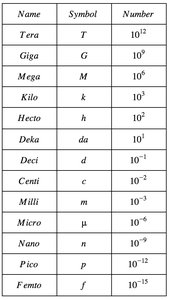
Example: The prefix 'kilo' (k) means 103, so 1 kilogram (kg) = 1,000 grams (g).
General Approach to Unit Conversions
To convert between units, follow these steps:
Identify the starting unit and the desired unit.
Determine the appropriate conversion factor(s).
Set up the calculation so that units cancel appropriately.
Multiply and simplify to obtain the answer in the desired unit.
Tip: Place 10# with the base unit and 1 with the different unit (prefix).
Worked Examples
Example 1: Converting Liters to Microliters
Question: How many microliters are in 1.5 liters?
Base unit: L
Different unit: µL
Conversion factor:
Setup:
Answer:
Example 2: Converting Nanometers to Centimeters
Question: How many centimeters are in 7.6 nanometers?
Base unit: m
Different units: nm and cm
Plan: nm → m → cm
Conversion factors: ,
Setup:
Answer:
Practice Problems
Convert 7.308 nL to L
Convert 0.0034 mm to cm
Convert 8.900 kg to g
Convert 406 cm to nm
Convert 9.0 L to mL
Convert 5.330 dm to pm
Solutions to Practice Problems
1. Convert 7.308 nL to L
Given: 7.308 nL
Conversion factor:
Plan: nL → L
Answer:
2. Convert 0.0034 mm to cm
Given: 0.0034 mm
Conversion factors: ,
Plan: mm → m → cm
Answer:
3. Convert 8.900 kg to g
Given: 8.900 kg
Conversion factor:
Plan: kg → g
Answer:
4. Convert 406 cm to nm
Given: 406 cm
Conversion factors: ,
Plan: cm → m → nm
Answer:
5. Convert 9.0 L to mL
Given: 9.0 L
Conversion factor:
Plan: L → mL
Answer:
6. Convert 5.330 dm to pm
Given: 5.330 dm
Conversion factors: ,
Plan: dm → m → pm
Answer:
Summary Table: Metric Prefixes
The following table summarizes the most common metric prefixes, their symbols, and their numerical values:
Name | Symbol | Number |
|---|---|---|
Tera | T | |
Giga | G | |
Mega | M | |
Kilo | k | |
Hecto | h | |
Deka | da | |
Deci | d | |
Centi | c | |
Milli | m | |
Micro | \mu | |
Nano | n | |
Pico | p | |
Femto | f |
Application: Use this table to quickly identify conversion factors for unit conversions in chemistry.
