Back
BackUnits of Measurement for Physical and Chemical Change
Study Guide - Smart Notes
 Tailored notes based on your materials, expanded with key definitions, examples, and context.
Units of Measurement for Physical and Chemical Change
1.1 Physical and Chemical Changes and Properties
Chemistry is the science that seeks to understand the properties and behavior of matter by studying the properties and behavior of atoms and molecules. Matter can undergo physical or chemical changes, and these changes are characterized by their respective properties.
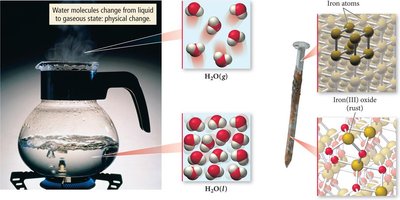
Physical Change: A change that does not alter the chemical composition of a substance (e.g., boiling water).
Chemical Change: A change that alters the chemical composition of a substance (e.g., rusting of iron).
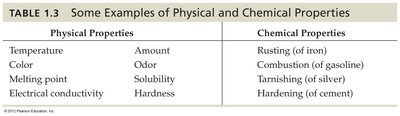
Physical Properties: Characteristics that do not involve a change in a sample’s chemical makeup (e.g., temperature, color, melting point).
Chemical Properties: Characteristics that do involve a change in a sample’s chemical makeup (e.g., rusting, combustion).
Physical Properties | Chemical Properties |
|---|---|
Temperature | Rusting (of iron) |
Color | Combustion (of gasoline) |
Melting point | Tarnishing (of silver) |
Electrical conductivity | Hardening (of cement) |
Amount | |
Odor | |
Solubility | |
Hardness |
Intensive Properties: Independent of sample size (e.g., temperature, melting point).
Extensive Properties: Dependent on sample size (e.g., length, volume).
1.2 Energy: A Fundamental Part of Physical and Chemical Change
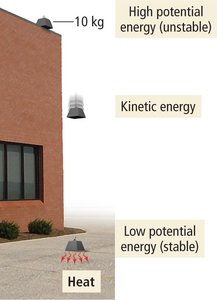
Energy is the capacity to do work. Work is defined as the action of a force through a distance. Energy can be classified as kinetic (energy of motion) or potential (stored energy due to position or composition).
Kinetic Energy: Energy associated with motion.
Potential Energy: Energy stored due to an object’s position or arrangement.
Energy can be converted from one form to another, such as potential energy converting to kinetic energy and then to heat.
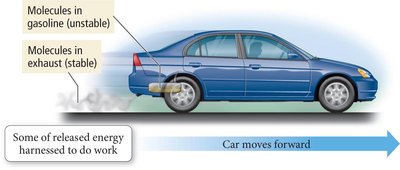
In chemical reactions, energy stored in molecules (chemical energy) can be released and harnessed to do work, such as moving a car.
1.3 The Units of Measurement
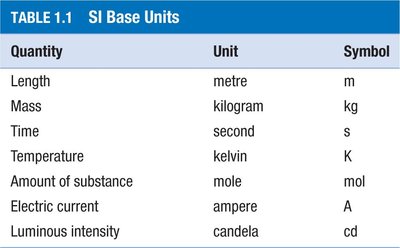
Measurements in chemistry are based on the International System of Units (SI). Each physical quantity has a standard unit.
Quantity | Unit | Symbol |
|---|---|---|
Length | metre | m |
Mass | kilogram | kg |
Time | second | s |
Temperature | kelvin | K |
Amount of substance | mole | mol |
Electric current | ampere | A |
Luminous intensity | candela | cd |
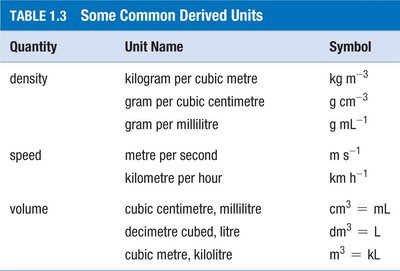
Derived units are combinations of base units, such as density, speed, and volume.
Quantity | Unit Name | Symbol |
|---|---|---|
Density | kilogram per cubic metre | kg\ m^{-3} |
Density | gram per cubic centimetre | g\ cm^{-3} |
Density | gram per millilitre | g\ mL^{-1} |
Speed | metre per second | m\ s^{-1} |
Speed | kilometre per hour | km\ h^{-1} |
Volume | cubic centimetre, millilitre | cm^3 = mL |
Volume | decimetre cubed, litre | dm^3 = L |
Volume | cubic metre, kilolitre | m^3 = kL |
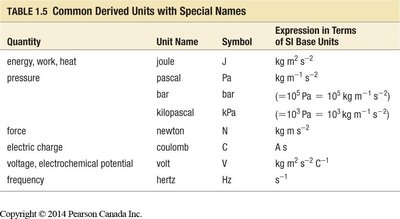
Some derived units have special names, such as joule for energy and newton for force.
Quantity | Unit Name | Symbol | Expression in SI Base Units |
|---|---|---|---|
Energy, work, heat | joule | J | kg\ m^2\ s^{-2} |
Pressure | pascal | Pa | kg\ m^{-1}\ s^{-2} |
Force | newton | N | kg\ m\ s^{-2} |
Electric charge | coulomb | C | A\ s |
Voltage | volt | V | kg\ m^2\ s^{-3}\ C^{-1} |
Frequency | hertz | Hz | s^{-1} |
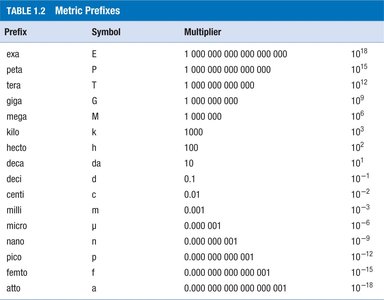
SI prefixes are used to express multiples or fractions of units.
Prefix | Symbol | Multiplier |
|---|---|---|
kilo | k | 10^3 |
centi | c | 10^{-2} |
milli | m | 10^{-3} |
micro | \mu | 10^{-6} |
nano | n | 10^{-9} |
pico | p | 10^{-12} |
femto | f | 10^{-15} |
atto | a | 10^{-18} |
1.4 The Reliability of a Measurement
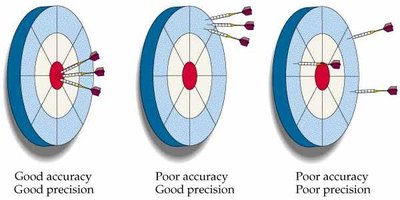
Reliability in measurement is assessed by accuracy, precision, and significant figures.
Accuracy: How close a measurement is to the true value.
Precision: How close repeated measurements are to each other.
Significant Figures: The total number of digits recorded for a measurement, reflecting the precision of the measurement.
Rules for counting significant figures:
All nonzero digits are significant.
Interior zeros are always significant.
Leading zeros are not significant.
Trailing zeros are significant if after a decimal point or before a decimal point in a number with a decimal shown.
Rules for rounding:
If the first digit removed is less than 5, round down.
If the first digit removed is 5 or greater, round up.
Rules for significant figures in calculations:
Multiplication/Division: The result should have the same number of significant figures as the value with the fewest significant figures.
Addition/Subtraction: The result should have the same number of decimal places as the value with the fewest decimal places.
1.5 Solving Chemical Problems
Problem solving in chemistry involves a systematic approach:
Identify the given information.
Identify what you must find.
Devise a conceptual plan.
Solve the problem based on your plan.
Check your answer for reasonableness.
Order-of-magnitude estimations are used for quick, approximate calculations. If the decimal part is less than 5, round down; if greater than 5, round up.
1.6 Estimation in Weighing
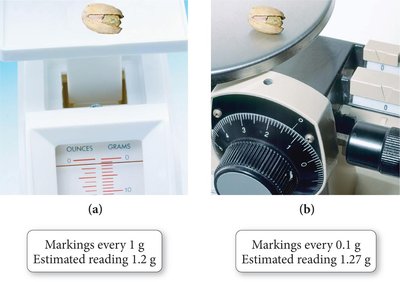
When weighing objects, the precision of the measurement depends on the instrument used. The last digit is always an estimate, reflecting the uncertainty in the measurement.