 Back
BackValence Bond Theory, Hybridization, and Molecular Orbital Theory
Study Guide - Smart Notes
 Tailored notes based on your materials, expanded with key definitions, examples, and context.
Valence Bond Theory and Hybridization
Introduction to Valence Bond Theory
Valence bond (VB) theory explains the formation of covalent bonds as the result of the overlap of atomic orbitals, each containing one electron of opposite spin. The electron pair in the overlapping orbital is shared by both atoms, and the strength of the bond depends on the extent of orbital overlap. Hybridization is used to explain molecular shapes that cannot be described by simple atomic orbital overlap.
Covalent bonds form through the overlap of atomic orbitals.
Each bonded atom maintains its own atomic orbitals, but the shared electron pair occupies the overlapping region.
Greater orbital overlap leads to stronger, more directional bonds.
Hybridization of atomic orbitals on the central atom is often necessary to explain observed molecular geometries.
sp Hybridization
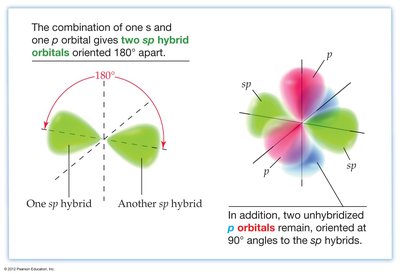
sp hybridization occurs when one s and one p orbital combine to form two equivalent sp hybrid orbitals, oriented 180° apart. This hybridization is characteristic of linear molecules with two charge clouds around the central atom.
Number of charge clouds: 2
Geometry: Linear (180° bond angle)
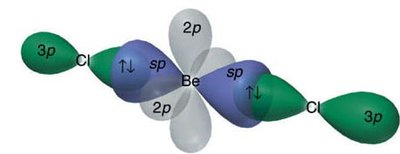
Example: BeCl2 (beryllium chloride)
In BeCl2, the two sp hybrid orbitals on Be overlap with the 3p orbitals of Cl atoms to form two sigma bonds.
sp2 Hybridization
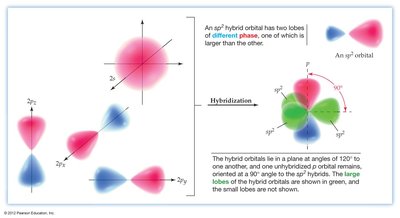
sp2 hybridization involves the combination of one s and two p orbitals to form three equivalent sp2 hybrid orbitals, arranged 120° apart in a trigonal planar geometry. One unhybridized p orbital remains perpendicular to the plane.
Number of charge clouds: 3
Geometry: Trigonal planar (120° bond angles)
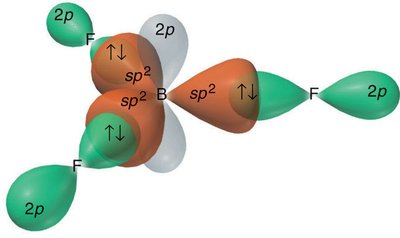
Example: BF3 (boron trifluoride)
In BF3, the three sp2 hybrid orbitals on B overlap with the 2p orbitals of F atoms to form three sigma bonds.
sp3 Hybridization
sp3 hybridization results from the combination of one s and three p orbitals, forming four equivalent sp3 hybrid orbitals arranged tetrahedrally (109.5° bond angles). This hybridization is typical for molecules with four charge clouds around the central atom.
Number of charge clouds: 4
Geometry: Tetrahedral (109.5° bond angles)
Example: CH4 (methane)
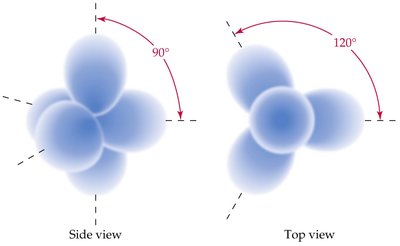
sp3d and sp3d2 Hybridization
For molecules with five or six charge clouds, d orbitals participate in hybridization:
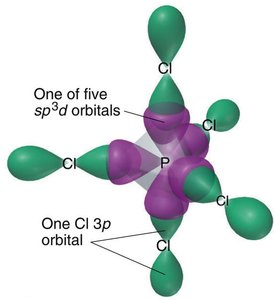
sp3d hybridization: Five hybrid orbitals, trigonal bipyramidal geometry (90° and 120° bond angles). Example: PCl5.
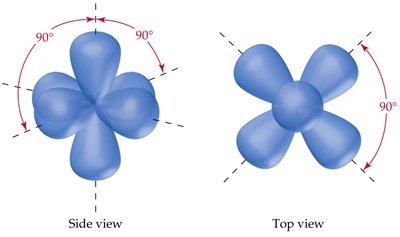
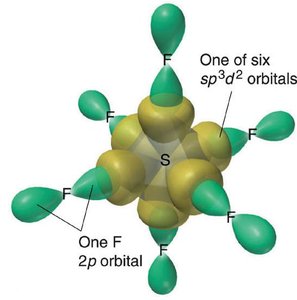
sp3d2 hybridization: Six hybrid orbitals, octahedral geometry (90° bond angles). Example: SF6.
Summary Table: Number of Charge Clouds and Hybridization
Number of Charge Clouds | Hybridization |
|---|---|
2 | sp |
3 | sp2 |
4 | sp3 |
5 | sp3d |
6 | sp3d2 |
Valence Bond Theory and Multiple Bonds
Double and Triple Bonds
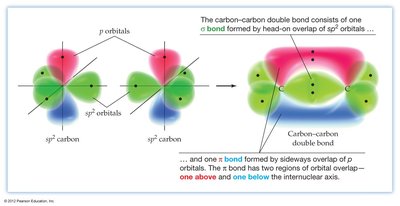
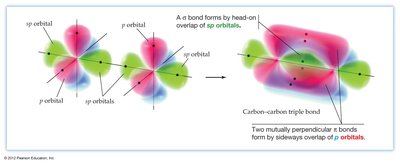
Multiple bonds are explained by the overlap of unhybridized p orbitals. A double bond consists of one sigma (σ) bond (from head-on overlap of hybrid orbitals) and one pi (π) bond (from sideways overlap of p orbitals). A triple bond consists of one sigma bond and two pi bonds.
Double bond: 1 σ + 1 π bond (e.g., C2H4, ethene)
Triple bond: 1 σ + 2 π bonds (e.g., C2H2, acetylene)
Molecular Orbital Theory
Introduction to Molecular Orbitals
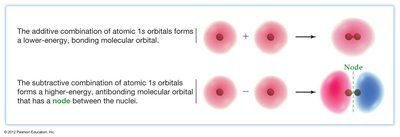
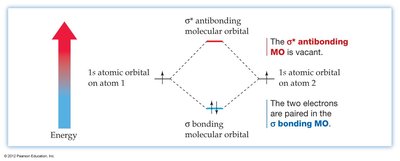
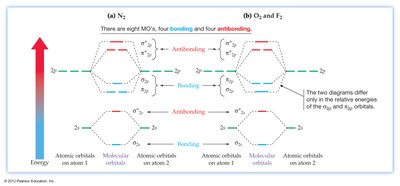
Molecular orbital (MO) theory describes bonding by considering the combination of atomic orbitals to form molecular orbitals that extend over the entire molecule. Electrons are placed in these orbitals according to the Aufbau principle, Pauli exclusion principle, and Hund's rule.
Bonding MO: Lower in energy, increases electron density between nuclei.
Antibonding MO: Higher in energy, has a node between nuclei.
Bond Order
Bond order is a measure of bond strength and is calculated as:
A bond order greater than zero indicates a stable molecule.
Bond order is proportional to bond strength and inversely proportional to bond length.
MO Diagrams for Diatomic Molecules
MO diagrams show the relative energies and electron configurations of molecular orbitals for diatomic molecules. The ordering of MOs can vary depending on the elements involved (e.g., N2 vs. O2).
Magnetic Properties
MO theory explains the magnetic properties of molecules:
Diamagnetic: All electrons are paired; molecule is weakly repelled by a magnetic field (e.g., N2).
Paramagnetic: Contains unpaired electrons; molecule is attracted to a magnetic field (e.g., O2).
Resonance in VB and MO Theory
Resonance Structures
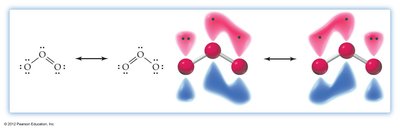
Valence bond theory explains resonance as the weighted average of multiple resonance structures, each representing a possible arrangement of electrons. MO theory describes resonance by delocalizing electrons across the entire molecule in molecular orbitals.
Summary Table: Hybridization and Molecular Shape
Number of Charge Clouds | Hybridization |
|---|---|
2 | sp |
3 | sp2 |
4 | sp3 |
5 | sp3d |
6 | sp3d2 |
Additional info: These notes integrate both valence bond and molecular orbital theories, providing a comprehensive overview of bonding, hybridization, and molecular structure for general chemistry students.
