 Back
Valence Bond Theory, Orbital Overlap, and Molecular Polarity
Study Guide - Smart Notes
 Tailored notes based on your materials, expanded with key definitions, examples, and context.
Valence Bond Theory and Modes of Orbital Overlap
Introduction to Valence Bond Theory
Valence Bond Theory (VBT) explains the formation of covalent bonds in molecules by considering the overlap of atomic orbitals from bonding atoms. This theory provides insight into how atoms share electrons and how molecular shapes arise from orbital interactions.
Covalent Bond Formation: Occurs when two half-filled atomic orbitals from different atoms overlap, allowing electron pairing.
Orbital Overlap: The greater the overlap, the stronger and more stable the bond.
Directionality: Covalent bonds are directional, with the bond axis defined by the region of orbital overlap.
Bond Strength: Increased electron density between nuclei stabilizes the molecule.
Types of Covalent Bonds: σ and π Bonds
Covalent bonds are classified based on the pattern of orbital overlap:
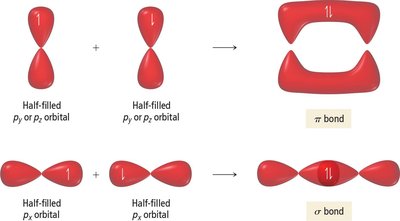
σ (Sigma) Bond: Formed by head-on overlap along the internuclear axis; electron density is concentrated between the nuclei and is cylindrically symmetric.
π (Pi) Bond: Formed by sidewise overlap of p orbitals; electron density is above and below the internuclear axis.
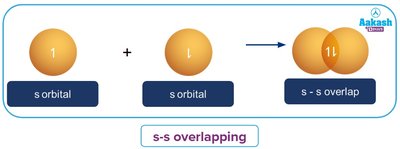
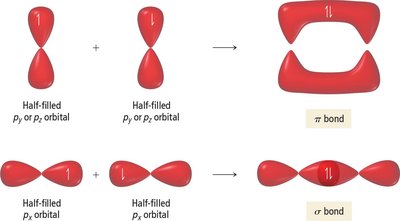
Orbital Overlap and Bonding Examples
s-s Overlap: Two s orbitals overlap to form a σ bond.
p-p Overlap: Two p orbitals can overlap head-on (σ bond) or sidewise (π bond).
Bonding in HCl: Overlap of H 1s and Cl 3p orbitals forms a σ bond.
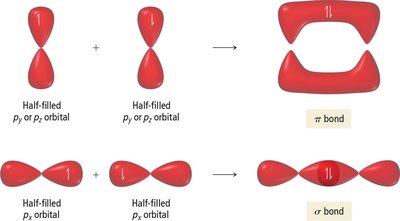
Molecular Shapes and Polarities
Determining Molecular Polarity
Molecular polarity arises from the arrangement of polar bonds and the overall shape of the molecule. The net dipole moment is determined by vector addition of individual bond dipoles.
Bond Dipole: A bond between atoms of different electronegativities creates a dipole, with partial positive (δ+) and partial negative (δ−) charges.
Net Dipole Moment: The sum of all bond dipoles; if they cancel, the molecule is nonpolar; if not, the molecule is polar.
Unit: Dipole moments are measured in Debye (D), where 1 D ≈ 3.34 × 10⁻³⁰ C·m.
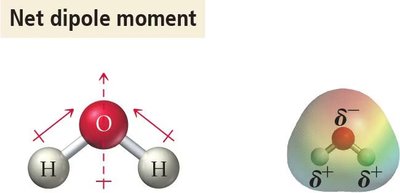
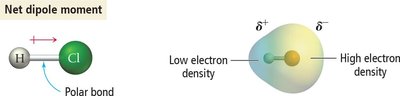
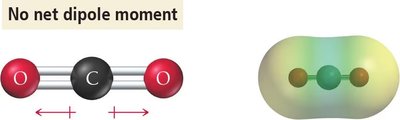
Common Cases of Adding Dipole Moments
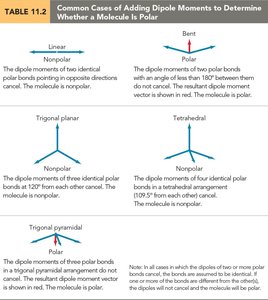
The polarity of a molecule depends on its geometry and the arrangement of polar bonds. The following table summarizes typical cases:
Geometry | Polarity | Description |
|---|---|---|
Linear | Nonpolar | Dipoles cancel if identical bonds are opposite. |
Bent | Polar | Dipoles do not cancel; net dipole exists. |
Trigonal Planar | Nonpolar | Three identical polar bonds at 120° cancel. |
Tetrahedral | Nonpolar | Four identical polar bonds at 109.5° cancel. |
Trigonal Pyramidal | Polar | Three polar bonds in a pyramidal arrangement do not cancel. |
Permanent Dipole Moments of Polar Molecules
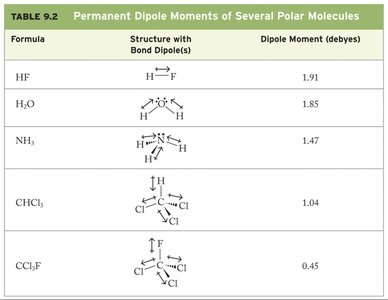
The following table lists dipole moments for several common polar molecules:
Formula | Structure with Bond Dipole(s) | Dipole Moment (D) |
|---|---|---|
HF | H→F | 1.91 |
H2O | H→O←H | 1.85 |
NH3 | H→N←H H | 1.47 |
CHCl3 | Cl Cl–C–H Cl | 1.04 |
CCl2F2 | Cl Cl–C–F F | 0.45 |
Valence Bond Theory – Orbital Hybridization
Hybrid Orbitals: Formation and Properties
Hybridization is the process by which atomic orbitals mix to form new, equivalent hybrid orbitals, optimizing bond formation and molecular geometry.
Hybrid Orbitals: Localized on single atoms, but have different shapes and energies compared to standard atomic orbitals.
Directionality: Hybrid orbitals are more directional, allowing greater overlap and stabilization.
Energy Considerations: Hybridization occurs only if the energy gained from bond formation exceeds the energy cost of hybridization.
Central Atoms: Central/interior atoms are more likely to hybridize than terminal atoms.
Conservation: The number of hybrid orbitals equals the number of atomic orbitals mixed.
Hybridization and Molecular Geometry
The type of hybridization determines the geometry of the molecule:
sp3 Hybridization: Tetrahedral geometry (e.g., CH4, NH3, H2O).
sp2 Hybridization: Trigonal planar geometry (e.g., CH2O).
sp Hybridization: Linear geometry (e.g., C2H2).
Example: Methane (CH4)
Methane exhibits tetrahedral geometry due to sp3 hybridization of the central carbon atom, resulting in four equivalent bonds with bond angles of 109.5°.
Atomic Orbitals Mixed: One s and three p orbitals.
Result: Four sp3 hybrid orbitals oriented tetrahedrally.
Example: Water (H2O) and Ammonia (NH3)
Both molecules have tetrahedral electron geometry due to sp3 hybridization, but lone pairs affect the observed molecular shape.
Water: Two bonding pairs and two lone pairs; bent shape.
Ammonia: Three bonding pairs and one lone pair; trigonal pyramidal shape.
Example: Formaldehyde (CH2O)
Formaldehyde has a trigonal planar shape due to sp2 hybridization of the central carbon atom.
Atomic Orbitals Mixed: One s and two p orbitals.
Result: Three sp2 hybrid orbitals oriented at 120°.
Single vs Double Bonds and Intramolecular Rotation
Single Bonds: Allow free rotation due to σ bond symmetry.
Double Bonds: Restrict rotation due to the presence of a π bond.
Summary Table: Hybridization Schemes from Electron Geometries
Electron Geometry | Hybridization | Example |
|---|---|---|
Linear | sp | BeCl2 |
Trigonal Planar | sp2 | BF3 |
Tetrahedral | sp3 | CH4 |
Trigonal Bipyramidal | sp3d | PCl5 |
Octahedral | sp3d2 | SF6 |
Additional info: Hybridization is a key concept in understanding molecular geometry, bond strength, and chemical reactivity. VSEPR theory is often used to predict the electron geometry and corresponding hybridization type. ----------------------------------------
