 Back
Valence Electrons, Bonding, and Lattice Energy: General Chemistry I Study Guide
Study Guide - Smart Notes
 Tailored notes based on your materials, expanded with key definitions, examples, and context.
Q1. Indicate whether the following statements regarding valence electrons are true (T) or false (F). Justify your answer in each case.
a) An element’s number of valence electrons is the same as its atomic number.
b) The hydrogen atom is most stable when it has a full octet of electrons.
Background
Topic: Valence Electrons and Stability
This question tests your understanding of how valence electrons relate to atomic number and the stability of hydrogen.
Key Terms:
Valence electrons: Electrons in the outermost shell of an atom, involved in bonding.
Atomic number: Number of protons in the nucleus of an atom.
Octet rule: Atoms tend to be most stable when they have eight electrons in their valence shell (exceptions exist).
Step-by-Step Guidance
Recall that the atomic number represents the number of protons, not necessarily the number of valence electrons.
Consider how valence electrons are determined for main group elements (look at their group number in the periodic table).
Think about hydrogen: it has one electron and is stable when it has two electrons (duet rule), not eight.
Justify your answers based on these concepts.
Try solving on your own before revealing the answer!
Final Answer:
a) False. The number of valence electrons is not always equal to the atomic number; it depends on the group in the periodic table.
b) False. Hydrogen is stable with two electrons (duet), not eight (octet).
Valence electrons are determined by the group number for main group elements, and hydrogen follows the duet rule.
Q2. Consider the element silicon. What is its electron configuration and how many valence electrons does it have?
Background
Topic: Electron Configuration and Valence Electrons
This question tests your ability to write electron configurations and identify valence electrons for a main group element.
Key Terms and Formula:
Electron configuration: The arrangement of electrons in an atom's orbitals.
Valence electrons: Electrons in the outermost shell.
Step-by-Step Guidance
Find silicon on the periodic table (atomic number 14).
Write the electron configuration using the order of filling: , , , , .
Identify the electrons in the outermost shell (third shell for silicon).
Try solving on your own before revealing the answer!
Final Answer:
Silicon's electron configuration is . It has 4 valence electrons (those in the and orbitals).
Q3. Write the Lewis symbol for each of the following atoms or ions.
a) K
b) N3-
Background
Topic: Lewis Symbols
This question tests your ability to represent atoms and ions using Lewis symbols, which show valence electrons.
Key Terms:
Lewis symbol: A diagram showing the element's symbol and its valence electrons as dots.
Ion: An atom with a net charge due to loss or gain of electrons.
Step-by-Step Guidance
Determine the number of valence electrons for potassium (K) and for the nitride ion (N3-).
Draw the element symbol and place dots around it to represent valence electrons.
For ions, adjust the number of electrons to reflect the charge.
Try solving on your own before revealing the answer!
Final Answer:
K has 1 valence electron, so its Lewis symbol is K with one dot. N3- has 8 valence electrons (gains 3), so its Lewis symbol is N with eight dots and a 3- charge.
Q4. Predict the chemical formula of the ionic compound formed between the following pairs of elements:
a) Al and F
b) Mg and N
Background
Topic: Ionic Compounds and Chemical Formulas
This question tests your ability to predict formulas based on the charges of ions formed by each element.
Key Terms:
Ionic compound: Compound formed by the electrostatic attraction between cations and anions.
Charge balance: The total positive and negative charges must balance in the formula.
Step-by-Step Guidance
Determine the charges of the ions formed by Al, F, Mg, and N.
Use the criss-cross method to balance the charges and write the formula.
Check that the total charge is zero in each formula.
Try solving on your own before revealing the answer!
Final Answer:
Al forms Al3+, F forms F-, so the formula is AlF3. Mg forms Mg2+, N forms N3-, so the formula is Mg3N2.
Q5. Write the electron configuration for each of the following ions, and determine which ones possess noble-gas configurations.
a) Sr2+
b) Ti2+
c) Mn3+
Background
Topic: Electron Configurations of Ions
This question tests your ability to write electron configurations for ions and recognize noble-gas configurations.
Key Terms:
Noble-gas configuration: Electron configuration matching that of a noble gas (full valence shell).
Electron configuration: Arrangement of electrons in orbitals.
Step-by-Step Guidance
Write the electron configuration for the neutral atom.
Remove electrons according to the charge (from the outermost shell first).
Compare the resulting configuration to that of a noble gas.
Try solving on your own before revealing the answer!
Final Answer:
Sr2+: (noble-gas configuration)
Ti2+: (not noble-gas)
Mn3+: (not noble-gas)
Only Sr2+ has a noble-gas configuration.
Q6. Is lattice energy usually endothermic or exothermic? Why?
Background
Topic: Lattice Energy
This question tests your understanding of the energy changes involved in forming ionic solids.
Key Terms:
Lattice energy: The energy released when ions form an ionic solid from the gaseous state.
Endothermic: Absorbs energy.
Exothermic: Releases energy.
Step-by-Step Guidance
Recall the definition of lattice energy: formation of a solid from gaseous ions.
Consider whether energy is released or absorbed during this process.
Think about why the process is energetically favorable.
Try solving on your own before revealing the answer!
Final Answer:
Lattice energy is usually exothermic because energy is released when oppositely charged ions come together to form a solid.
Q26. Using Table 8.3 shown below, estimate ΔH for the following gas-phase reaction. Note: Lone pairs on atoms are not shown.
C2H4 + H2O2 → C2O2H6
Background
Topic: Bond Enthalpy and Reaction Enthalpy
This question tests your ability to use average bond enthalpies to estimate the enthalpy change (ΔH) for a reaction.
Key Terms and Formula:
Bond enthalpy: Energy required to break a bond in a molecule.
ΔH (reaction enthalpy): Estimated using bond enthalpies.
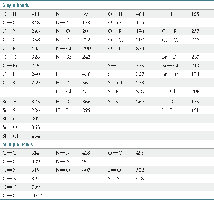
Key formula:
Step-by-Step Guidance
Identify all bonds broken in the reactants (C2H4 and H2O2).
Identify all bonds formed in the product (C2O2H6).
Use the bond enthalpy values from Table 8.3 to sum the energies for bonds broken and formed.
Set up the calculation for ΔH using the formula above.
Try solving on your own before revealing the answer!
Final Answer:
ΔH ≈ [Sum of bond energies broken] - [Sum of bond energies formed]. After plugging in the values from Table 8.3, the estimated ΔH for the reaction is -232 kJ/mol.
This negative value indicates the reaction is exothermic.
