 Back
BackWater Analysis: pH and Alkalinity
Study Guide - Smart Notes
 Tailored notes based on your materials, expanded with key definitions, examples, and context.
WATER ANALYSIS
pH – Acidity and Alkalinity
The analysis of water involves understanding its acidity and alkalinity, which are critical for environmental chemistry and water quality assessment. The pH scale is used to express the intensity of the acid or alkaline condition of a solution, reflecting the hydrogen ion activity.
pH Definition: pH is a measure of the hydrogen ion concentration in a solution, indicating its acidity or alkalinity.
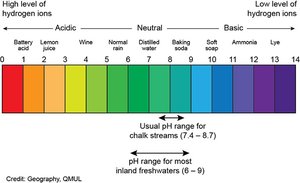
Acidic Solutions: pH less than 7, high concentration of hydrogen ions.
Neutral Solutions: pH equal to 7, balanced hydrogen and hydroxide ions.
Basic Solutions: pH greater than 7, low concentration of hydrogen ions.
Environmental Relevance: Most natural waters have a pH between 6 and 9.
Formula:
Example: Lemon juice (pH ~2), distilled water (pH ~7), ammonia (pH ~11).
ALKALINITY
Alkalinity and Its Measurement
Alkalinity is the capacity of water to neutralize acids, primarily due to the presence of hydroxide, carbonate, and bicarbonate ions. It is an important parameter in water chemistry, affecting biological and chemical processes.
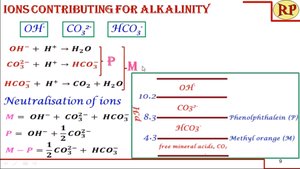
Phenolphthalein Alkalinity: Measures hydroxides and half the carbonates at pH 8.3. At this point, all hydroxyl ions are neutralized and carbonates are converted to bicarbonates.
Total Alkalinity: Determined by titrating to pH 3.7 (methyl orange endpoint), where all alkaline compounds are neutralized. Includes all titrant added from the start, including that used to reach the phenolphthalein endpoint.
Titration Curve: The titration curve for a hydroxide-carbonate mixture shows inflections at pH 10.2 (hydroxide), pH 8.3 (carbonate), and pH 4.3 (bicarbonate).
Formula for Alkalinity Calculation:
Example: Water sample titrated with sulfuric acid to pH 3.7 to determine total alkalinity.
Ions Contributing to Alkalinity
The main ions contributing to alkalinity in water are hydroxide (OH-), carbonate (CO32-), and bicarbonate (HCO3-). Their presence and concentration determine the water's ability to neutralize acids.
Hydroxide (OH-): Contributes to alkalinity at high pH (above 10).
Carbonate (CO32-): Present at pH above 8.3.
Bicarbonate (HCO3-): Dominant at pH below 8.3.
Neutralization Reactions:
OH- + H+ → H2O
CO32- + H+ → HCO3-
HCO3- + H+ → CO2 + H2O
Classification of Alkalinity Situations
Depending on the ions present, water samples can be classified into five possible alkalinity situations:
Hydroxide Only: High pH (>10), titration ends at phenolphthalein endpoint.
Carbonates Only: High pH (≥8.5), carbonate is the main contributor.
Hydroxide-Carbonates: High pH (>10), both hydroxide and carbonate present.
Carbonates-Bicarbonates: pH between 8.3 and 11, both carbonate and bicarbonate present.
Bicarbonates Only: pH ≤8.3, bicarbonate is the main contributor.
Example: A water sample with pH 9.0 likely contains both carbonate and bicarbonate ions.
