 Back
Work, Heat, and Internal Energy in Thermodynamic Systems
Study Guide - Smart Notes
 Tailored notes based on your materials, expanded with key definitions, examples, and context.
Work, Heat, and Internal Energy
Work Done by a System
In thermodynamics, work is defined as the energy transferred when a force acts through a distance. For a gas confined in a cylinder with a movable piston, the gas can do work by expanding against the piston or have work done on it by compression. The work associated with volume changes is calculated as follows:
Infinitesimal Work: When the piston moves an infinitesimal distance dx, the work done by the gas is given by: where p is the pressure, A is the area of the piston, and dx is the displacement.
Change in Volume: Since , the work can be rewritten as:
Net Work for Finite Volume Change: For a change from to :
Quasi-static Process: This integral is meaningful only for processes that occur slowly, maintaining thermal equilibrium. The relationship between pressure and volume can be plotted on a pV diagram, where the area under the curve represents the work done.
Sign Convention: Work done by the gas is positive for expansion and negative for compression.
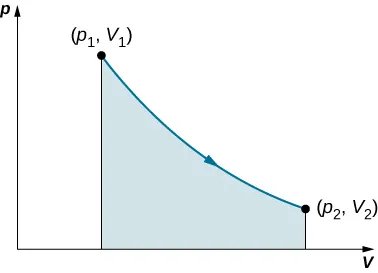
Example: In an isothermal expansion (constant temperature), the work done by an ideal gas is:
Using the ideal gas law :
If , the work is positive (expansion).
For an isobaric (constant pressure) process:
Path Dependence: The work done depends on the thermodynamic path taken between two states, not just the initial and final states.
Work Done by a van der Waals Gas
For real gases, the ideal gas law is modified to account for molecular volume and intermolecular forces. The van der Waals equation is:
For one mole, the pressure as a function of volume is:
The work done during isothermal expansion from to is:
If and , this reduces to the ideal gas result.
Internal Energy
The internal energy () of a thermodynamic system is the sum of the mechanical energies (kinetic and potential) of all molecules in the system:
Kinetic energy () includes translational, rotational, and vibrational components.
Potential energy () is due to interactions between molecules.
For an ideal monatomic gas, only translational kinetic energy is relevant, and is set to zero.
The average kinetic energy per molecule is: where is Boltzmann's constant and is temperature.
For moles: where is Avogadro's number and is the gas constant.
Temperature Dependence: For an ideal monatomic gas, internal energy depends only on temperature, not on pressure or volume.
Example: Mixing two monatomic ideal gases at different temperatures results in energy transfer until thermal equilibrium is reached, with both gases at the same temperature.
Additional info: For more complex systems (e.g., polyatomic gases, liquids, solids), internal energy includes rotational, vibrational, and interaction energies, and its dependence on state variables can be more complicated.
