Ch.7 - Periodic Properties of the Elements
Brown - Chemistry: The Central Science 14th Edition
Brown14th EditionChemistry: The Central ScienceISBN: 9780134414232Not the one you use?Change textbook
Chapter 7, Problem 94b

(b) Why does O3- not exist?

Verified step by step guidance
1
Understand the concept of electron configuration and stability: Atoms and ions are stable when they have a full valence shell, often following the octet rule, which states that atoms tend to have eight electrons in their valence shell.
Consider the electron configuration of oxygen: Oxygen has an atomic number of 8, meaning it has 8 electrons. Its electron configuration is 1s² 2s² 2p⁴, with 6 electrons in the outer shell.
Analyze the formation of O³⁻: Adding three extra electrons to an oxygen atom would result in the electron configuration 1s² 2s² 2p⁷, which exceeds the capacity of the 2p orbital, as it can only hold a maximum of 6 electrons.
Evaluate the stability of O³⁻: The addition of three electrons would create an unstable electron configuration, as it violates the octet rule and results in electron-electron repulsion due to overcrowding in the 2p orbital.
Conclude why O³⁻ does not exist: Due to the instability caused by exceeding the electron capacity of the 2p orbital and the violation of the octet rule, O³⁻ is not a feasible or stable ion, and thus, it does not exist.

Verified video answer for a similar problem:

This video solution was recommended by our tutors as helpful for the problem above.
Video duration:
3m

Key Concepts

Here are the essential concepts you must grasp in order to answer the question correctly.

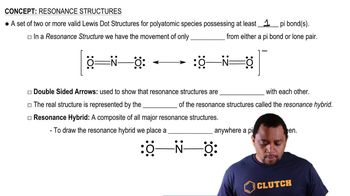
Ozone Structure

Ozone (O3) consists of three oxygen atoms arranged in a bent molecular geometry. This structure allows for resonance, where the double bond between the oxygen atoms can shift, stabilizing the molecule. However, when considering the O3- ion, the addition of an extra electron disrupts this balance, leading to instability.
Recommended video:
Guided course
01:42
Resonance Structures

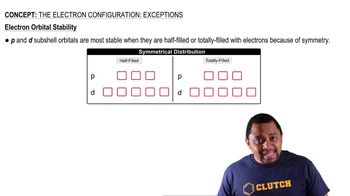
Electron Configuration and Stability

The stability of a molecule is heavily influenced by its electron configuration. Ozone has a specific arrangement of electrons that allows it to exist in a stable state. The addition of an extra electron to form O3- would create an unfavorable electron-electron repulsion, making the ion less stable and likely to decompose.
Recommended video:
Guided course
01:23
Electron Orbital Stability

Ionic vs. Molecular Species

Ozone is a molecular species, meaning it is formed by covalent bonds between atoms. In contrast, O3- would imply an ionic character due to the extra electron. The transition from a stable molecular form to an unstable ionic form is energetically unfavorable, which contributes to the non-existence of O3-.
Recommended video:
Guided course
03:03
Amphoteric Species