Skip to main content
Genetics
My Course
Learn
Exam Prep
AI Tutor
Study Guides
Textbook Solutions
Flashcards
Explore
Try the app
My Course
Learn
Exam Prep
AI Tutor
Study Guides
Textbook Solutions
Flashcards
Explore
Try the app
Back
Allelic Frequency Changes definitions
You can tap to flip the card.
Hardy-Weinberg Equilibrium
You can tap to flip the card.
👆
Hardy-Weinberg Equilibrium
A theoretical state where allele frequencies remain constant due to absence of evolutionary forces in a population.
Track progress
Control buttons has been changed to "navigation" mode.
1/15
Related flashcards
Related practice
Recommended videos
Allelic Frequency Changes quiz #1
Allelic Frequency Changes
22 Terms
Allelic Frequency Changes
21. Population Genetics
7 problems
Topic
Kylia
Hardy Weinberg
21. Population Genetics
7 problems
Topic
Kylia
21. Population Genetics
2 topics
6 problems
Chapter
Kylia
Guided course
10:15
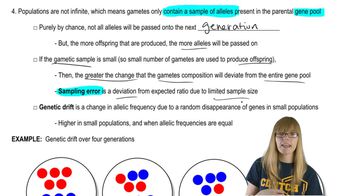
Genetic Drift
1126
views
9
rank
Guided course
03:03
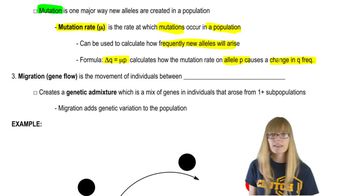
New Alleles and Migration
1485
views
7
rank
Guided course
07:55
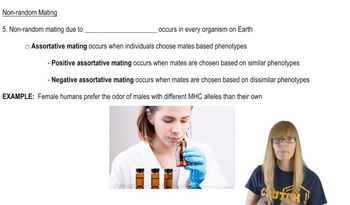
Non-Random Mating
1300
views
5
rank
Terms in this set (15)
Hide definitions
Hardy-Weinberg Equilibrium
A theoretical state where allele frequencies remain constant due to absence of evolutionary forces in a population.
Natural Selection
A process where certain genetic variants increase in frequency because they enhance survival or reproduction.
Directional Selection
A selection type where allele frequencies shift toward one extreme, often leading to fixation or loss.
Balancing Selection
A selection type maintaining multiple beneficial alleles at stable frequencies within a population.
Mutation
A source of new genetic variants, arising spontaneously and altering existing alleles or creating new ones.
Gene Flow
The movement of alleles between populations, increasing genetic variation through migration.
Genetic Drift
Random changes in allele frequencies, especially impactful in small populations, potentially causing fixation or loss.
Founder Effect
A reduction in genetic diversity when a new population is established by a small number of individuals.
Bottleneck Effect
A sharp decrease in population size leading to loss of genetic variation due to random survival.
Non-random Mating
Mating patterns influenced by phenotype or proximity, altering allele frequencies from expected random distributions.
Assortative Mating
A mating pattern where individuals choose partners with similar or dissimilar phenotypes, affecting genetic structure.
Inbreeding
Mating between relatives, increasing homozygosity and risk of recessive genetic disorders.
Inbreeding Coefficient
A measure indicating the probability that two alleles in an individual are identical by descent.
Reproductive Isolation
Barriers preventing gene flow between populations, leading to the formation of distinct species.
Speciation
The evolutionary process where genetic divergence leads to the emergence of new species.
 BackBack
 10:15
10:15