Skip to main content
Genetics
My Course
Learn
Exam Prep
AI Tutor
Study Guides
Textbook Solutions
Flashcards
Explore
Try the app
My Course
Learn
Exam Prep
AI Tutor
Study Guides
Textbook Solutions
Flashcards
Explore
Try the app
Back
Alternative DNA Forms definitions
You can tap to flip the card.
B-DNA
You can tap to flip the card.
👆
B-DNA
A right-handed helical structure, most prevalent in humans and other organisms, serving as the standard reference for DNA shape.
Track progress
Control buttons has been changed to "navigation" mode.
1/15
Related flashcards
Related practice
Recommended videos
Alternative DNA Forms quiz #1
Alternative DNA Forms
10 Terms
Alternative DNA Forms
7. DNA and Chromosome Structure
4 problems
Topic
Kylia
RNA
7. DNA and Chromosome Structure
3 problems
Topic
Kylia
7. DNA and Chromosome Structure
6 topics
14 problems
Chapter
Kylia
Guided course
01:57
Alternative DNA Forms
2008
views
27
rank
Terms in this set (15)
Hide definitions
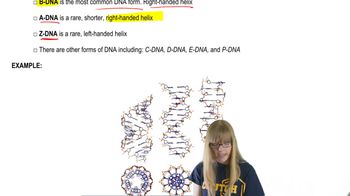
B-DNA
A right-handed helical structure, most prevalent in humans and other organisms, serving as the standard reference for DNA shape.
A-DNA
A shorter, right-handed helix that appears more compact and forms under conditions like low water availability.
Z-DNA
A left-handed helical structure, visually distinct by its reversed twist, often arising in high salt or unusual environments.
Right-handed Helix
A spiral structure twisting in the same direction as a standard screw, characteristic of B-DNA and A-DNA.
Left-handed Helix
A spiral structure twisting opposite to the standard, giving a reversed appearance, as seen in Z-DNA.
High Salt Concentration
A laboratory or environmental condition that can induce alternative DNA structures by altering molecular interactions.
Extreme pH
A non-neutral acidity or alkalinity level that can trigger the formation of less common DNA conformations.
Low Water Availability
A dehydrated state that promotes the formation of compact DNA structures like A-DNA.
C-DNA
A less common DNA variant, differing in size and structure, typically forming under specific laboratory conditions.
D-DNA
A rare DNA form with unique structural features, observed under unusual environmental or experimental settings.
E-DNA
An uncommon DNA conformation, distinct from B-DNA, arising under particular non-standard conditions.
P-DNA
A rare DNA structure, part of the spectrum of alternative forms, with unique physical properties.
V-DNA
A seldom-seen DNA variant, included among the alternative forms, with distinct structural characteristics.
Alternative DNA Forms
Structural variants of the DNA double helix that differ from the standard, often induced by environmental changes.
DNA Structure
The three-dimensional arrangement of nucleotide chains, which can vary in handedness, length, and compactness.
 BackBack
 01:57
01:57