Skip to main content
Genetics
My Course
Learn
Exam Prep
AI Tutor
Study Guides
Textbook Solutions
Flashcards
Explore
Try the app
My Course
Learn
Exam Prep
AI Tutor
Study Guides
Textbook Solutions
Flashcards
Explore
Try the app
Back
Chi Square and Linkage definitions
You can tap to flip the card.
Chi Square Test
You can tap to flip the card.
👆
Chi Square Test
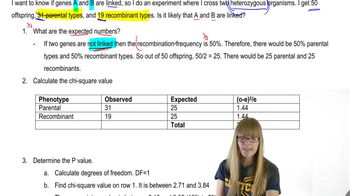
Statistical method comparing observed and expected values to assess the likelihood of genetic linkage.
Track progress
Control buttons has been changed to "navigation" mode.
1/14
Related flashcards
Related practice
Recommended videos
Chi Square and Linkage quiz
Chi Square and Linkage
15 Terms
Chi Square and Linkage
4. Genetic Mapping and Linkage
6 problems
Topic
Kylia
Mapping with Markers
4. Genetic Mapping and Linkage
4 problems
Topic
Kylia
4. Genetic Mapping and Linkage - Part 1 of 2
4 topics
11 problems
Chapter
Kylia
4. Genetic Mapping and Linkage - Part 2 of 2
5 topics
10 problems
Chapter
Kylia
Guided course
07:33
Chi Square and Linkage
2373
views
16
rank
7
comments
Terms in this set (14)
Hide definitions
Chi Square Test
Statistical method comparing observed and expected values to assess the likelihood of genetic linkage.
Gene Linkage
Physical proximity of genes on a chromosome, affecting their tendency to be inherited together.
Heterozygous Organism
Individual possessing two different alleles for a specific gene, crucial for linkage analysis crosses.
Parental Type
Offspring displaying the same trait combinations as the original parents in a genetic cross.
Recombinant Type
Offspring exhibiting new trait combinations not found in the parental generation.
Recombination Frequency
Proportion of recombinant offspring, indicating the likelihood of crossover between genes.
Null Hypothesis
Assumption that observed and expected results are not significantly different, implying no linkage.
Degrees of Freedom
Value calculated as the number of categories minus one, used to interpret statistical significance.
P Value
Probability indicating the likelihood that observed differences are due to chance, guiding hypothesis acceptance.
Critical Value
Threshold from statistical tables used to determine if the test statistic is significant.
Observed Value
Actual data collected from an experiment, such as the number of parental or recombinant offspring.
Expected Value
Predicted outcome based on the null hypothesis, serving as a comparison for observed results.
Statistical Significance
Measure indicating whether experimental results are unlikely to have occurred by random chance.
Confidence Level
Percentage expressing certainty in a statistical conclusion, such as 95% confidence in hypothesis testing.
 BackBack
 07:33
07:33