Skip to main content
Genetics
My Course
Learn
Exam Prep
AI Tutor
Study Guides
Textbook Solutions
Flashcards
Explore
Try the app
My Course
Learn
Exam Prep
AI Tutor
Study Guides
Textbook Solutions
Flashcards
Explore
Try the app
Back
Developmental Patterning Genes definitions
You can tap to flip the card.
Anterior
You can tap to flip the card.
👆
Anterior
Region designating the front or head end of an organism, established early in development by gene concentration gradients.
Track progress
Control buttons has been changed to "navigation" mode.
1/20
Related flashcards
Related practice
Recommended videos
Developmental Patterning Genes quiz #1
Developmental Patterning Genes
10 Terms
Developmental Patterning Genes
14. Genetic Control of Development
7 problems
Topic
Kylia
Early Developmental Steps
14. Genetic Control of Development
6 problems
Topic
Kylia
14. Genetic Control of Development
3 topics
8 problems
Chapter
Kylia
Guided course
11:19
Segmentation Genes
1023
views
4
rank
1
comments
Guided course
02:34
Plant HOX genes
1022
views
2
rank
Terms in this set (20)
Hide definitions
Anterior
Region designating the front or head end of an organism, established early in development by gene concentration gradients.
Posterior
Region marking the back end of an organism, determined by specific maternal gene concentrations during early embryogenesis.
Dorsal
Surface representing the top side of an organism, crucial for spatial orientation during embryonic patterning.
Ventral
Surface indicating the bottom side of an organism, defined during initial developmental stages.
Maternal Effect Genes
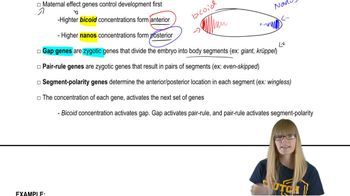
Genes from the mother’s egg that set up initial body axes and trigger the first steps of embryonic development.
Bicoid
Maternal gene product concentrated at the future head region, essential for anterior structure formation.
Nanos
Maternal gene product concentrated at the future tail region, vital for posterior structure specification.
Zygotic Genes
Genes of the developing embryo that take over after maternal genes, guiding later developmental processes.
Gap Genes
First zygotic genes dividing the embryo into broad segments, setting the stage for finer patterning.
Pair-Rule Genes
Genes that further subdivide broad segments into pairs, refining the embryonic body plan.
Segment Polarity Genes
Genes that define anterior and posterior within each segment, ensuring correct segment orientation.
Hox Genes
Highly conserved genes containing a homeobox, acting as transcription factors to specify segment identity.
Homeobox
A 180 base pair DNA sequence found in certain genes, encoding a protein domain that binds DNA.
Antennapedia Complex
Cluster of Hox genes in fruit flies controlling head and thorax development.
Bithorax Complex
Cluster of Hox genes in fruit flies responsible for specifying posterior thorax and abdominal segments.
Arabidopsis
Model plant organism used to study floral development and the function of plant Hox gene classes.
Sepal
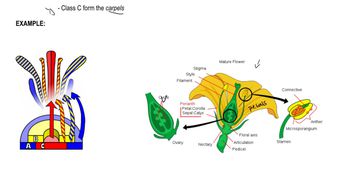
Leaf-like floral structure formed by Class A genes, protecting the developing flower bud.
Petal
Floral organ formed by the combined action of Class A and B genes, often colorful and attractive.
Stamen
Male reproductive floral part, specified by Class B and C genes, producing pollen.
Carpel
Female reproductive floral structure, formed by Class C gene expression, enclosing ovules.
 BackBack
 11:19
11:19