Skip to main content
Genetics
My Course
Learn
Exam Prep
AI Tutor
Study Guides
Textbook Solutions
Flashcards
Explore
Try the app
My Course
Learn
Exam Prep
AI Tutor
Study Guides
Textbook Solutions
Flashcards
Explore
Try the app
Back
Functional Genomics definitions
You can tap to flip the card.
Functional Genomics
You can tap to flip the card.
👆
Functional Genomics
Field analyzing gene roles, expression patterns, and molecular interactions to understand cellular function and regulation.
Track progress
Control buttons has been changed to "navigation" mode.
1/15
Related flashcards
Related practice
Recommended videos
Functional Genomics quiz
Functional Genomics
15 Terms
Functional Genomics
15. Genomes and Genomics
8 problems
Topic
Kylia
Proteomics
15. Genomes and Genomics
6 problems
Topic
Kylia
15. Genomes and Genomics - Part 1 of 2
5 topics
10 problems
Chapter
Kylia
15. Genomes and Genomics - Part 2 of 2
4 topics
10 problems
Chapter
Kylia
Guided course
08:26
Functional Genomics
1062
views
2
rank
Terms in this set (15)
Hide definitions
Functional Genomics
Field analyzing gene roles, expression patterns, and molecular interactions to understand cellular function and regulation.
Transcriptomics
Branch focusing on the complete set and expression levels of RNA transcripts present in a cell under specific conditions.
Proteomics
Study of the entire set of proteins produced in a cell, including their abundance, modifications, and functional roles.
Interactomics
Analysis of complex networks formed by interactions among DNA, RNA, and proteins within a biological system.
DNA Microarray
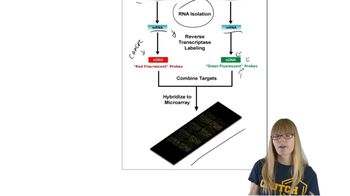
Technology using gene-specific probes to compare mRNA expression across samples, revealing active genes under various conditions.
cDNA
DNA synthesized from an mRNA template, used to represent gene expression profiles in experimental assays.
Reporter Gene
Genetic element encoding a detectable product, such as fluorescence, to indicate activity of a target promoter or interaction.
Two-Hybrid Test
Yeast-based assay detecting protein-protein interactions by reconstituting a split transcription factor, activating a visible marker.
Chromatin Immunoprecipitation
Technique isolating DNA regions bound by specific proteins using cross-linking and antibodies, followed by sequence identification.
Antibody
Protein molecule used to specifically bind and isolate target proteins or complexes in molecular biology experiments.
Reverse Genetics
Approach starting with a known gene sequence, introducing mutations, and observing resulting phenotypic changes.
Forward Genetics
Strategy beginning with an observed phenotype, then identifying the underlying genetic changes responsible.
Genotype
Complete genetic makeup of an organism, determining potential traits and responses to mutations.
Phenotype
Observable characteristics or traits of an organism resulting from genetic and environmental influences.
Green Fluorescent Protein
Fluorescent marker used in cells to visually report gene expression or protein interactions, emitting green light when active.
 BackBack
 08:26
08:26