What are the three main subdivisions of functional genomics?
The three main subdivisions are transcriptomics, proteomics, and interactomics.
What does transcriptomics study?
Transcriptomics studies the sequence and expression of RNA transcripts in cells.
How does proteomics differ from transcriptomics?
Proteomics studies the expression of proteins, which can differ from transcript levels due to post-transcriptional regulation.
What is the focus of interactomics?
Interactomics focuses on the interactions among DNA, RNA, and proteins.
What is the main purpose of DNA microarrays?
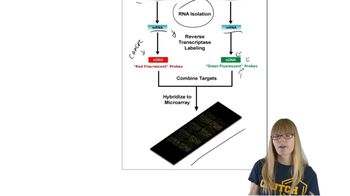
DNA microarrays are used to determine which genes are active in a particular cell under specific conditions.
How are mRNA levels from different cell types distinguished in a DNA microarray experiment?
mRNA from different cell types is labeled with different colors, such as red for cancer cells and green for normal cells.
What does a strong red signal on a DNA microarray indicate?
A strong red signal indicates high expression of a gene in cancer cells compared to normal cells.
What is the yeast two-hybrid test used for?
The yeast two-hybrid test is used to study protein-protein interactions.
How does the yeast two-hybrid system detect protein interactions?
It detects interactions by reconstituting a split protein only if the bait and prey proteins bind, activating a reporter gene like GFP.
What is the role of a reporter gene in the two-hybrid test?
A reporter gene, such as GFP, produces a detectable signal (like green fluorescence) when protein interaction occurs.
What does chromatin immunoprecipitation (ChIP) examine?
ChIP examines protein-DNA interactions by identifying where specific proteins bind to DNA sequences.
How are proteins and DNA cross-linked in ChIP experiments?
Chemicals are used to tightly bind (cross-link) proteins to DNA, making them difficult to separate.
Why is antibody specificity important in ChIP?
Antibody specificity ensures that only the protein of interest is isolated, allowing accurate identification of its DNA binding sites.
What is the main difference between reverse genetics and forward genetics?
Reverse genetics starts with a known gene and disrupts it to observe phenotypic changes, while forward genetics starts with a phenotype and seeks the underlying genotype.
In reverse genetics, what is the sequence of investigation?
In reverse genetics, researchers go from genotype (gene sequence) to phenotype (observable traits) by introducing mutations.
 Back
Back
 08:26
08:26