Skip to main content
Genetics
My Course
Learn
Exam Prep
AI Tutor
Study Guides
Textbook Solutions
Flashcards
Explore
Try the app
My Course
Learn
Exam Prep
AI Tutor
Study Guides
Textbook Solutions
Flashcards
Explore
Try the app
Back
Genetic Cloning definitions
You can tap to flip the card.
Genetic Cloning
You can tap to flip the card.
👆
Genetic Cloning
Process of producing large quantities of a specific DNA sequence for study or application using laboratory techniques.
Track progress
Control buttons has been changed to "navigation" mode.
1/15
Related flashcards
Related practice
Recommended videos
Genetic Cloning quiz #1
Genetic Cloning
10 Terms
Genetic Cloning
18. Molecular Genetic Tools
7 problems
Topic
Kylia
Methods for Analyzing DNA
18. Molecular Genetic Tools
7 problems
Topic
Kylia
18. Molecular Genetic Tools
2 topics
6 problems
Chapter
Kylia
Guided course
07:39
Genetic Cloning
1888
views
30
rank
2
comments
Terms in this set (15)
Hide definitions
Genetic Cloning
Process of producing large quantities of a specific DNA sequence for study or application using laboratory techniques.
Polymerase Chain Reaction
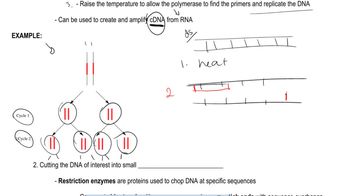
Technique that amplifies DNA by cycling through denaturation, primer annealing, and extension to generate millions of copies.
Restriction Enzyme
Protein that recognizes and cuts DNA at specific sequences, generating fragments with defined ends.
Sticky End
Single-stranded DNA overhang created by certain enzymes, facilitating the joining of DNA fragments with complementary sequences.
Blunt End
DNA fragment end with no overhangs, resulting from a straight cut by specific enzymes, less efficient for joining.
Vector
DNA molecule, often a plasmid, used to carry foreign genetic material into a host cell for replication.
Plasmid
Circular DNA molecule found in bacteria, commonly used as a vehicle for gene insertion in cloning experiments.
Recombinant DNA
Genetic material formed by joining DNA fragments from different sources, enabling new genetic combinations.
DNA Ligase
Enzyme that seals breaks in the DNA backbone, joining fragments by forming phosphodiester bonds.
Bacterial Artificial Chromosome
Large vector designed to clone substantial DNA fragments, useful for genomic studies in bacteria.
Yeast Artificial Chromosome
Engineered vector for cloning large DNA segments, enabling manipulation and study in yeast cells.
Transgenic Organism
Living entity that contains and expresses a gene introduced from another species, often for research or production.
Transgene
Foreign gene inserted into an organism’s genome, resulting in new traits or protein production.
cDNA
DNA synthesized from an RNA template via reverse transcription, often used for cloning expressed genes.
Primer
Short nucleotide sequence that provides a starting point for DNA synthesis during amplification processes.
 BackBack
 07:39
07:39