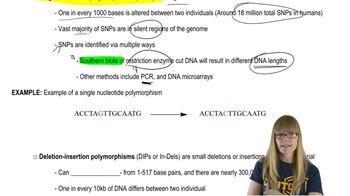
A SNP is a single nucleotide change in the DNA sequence, such as an A to a C or a G to a T.
How frequent are SNPs in the human genome?
SNPs occur about once every 1,000 bases, totaling approximately 18 million in the human genome.
Where are most SNPs found in the human genome?
Most SNPs are found in non-coding regions that do not affect protein function.
Why are SNPs important for scientists even if they do not affect proteins?
SNPs are useful for genetic identification and studying evolutionary relationships between individuals.
Name three techniques used to identify SNPs.
SNPs can be identified using Southern blotting, PCR, and DNA microarrays.
How do restriction enzymes help identify SNPs?
Restriction enzymes cut DNA at specific sequences, and SNPs can alter these sites, resulting in different DNA fragment lengths.
What is a deletion/insertion polymorphism (indel)?
An indel is a small deletion or insertion of genetic material, ranging from 1 to 517 base pairs.
How common are indels in the human genome?
There are nearly 300,000 indels in the human genome, occurring about once every 10,000 bases.
What are simple sequence repeats (SSRs) and how do they arise?
SSRs are short sequences of 1-3 bases repeated 15 to 100 times, often arising from DNA replication errors.
Which disease is associated with a simple sequence repeat expansion?
Huntington's disease is associated with an expanded CAG simple sequence repeat.
How frequent are CA simple sequence repeats in mammalian genomes?
CA repeats are found about once every 30,000 base pairs in mammalian genomes.
What are mini satellites and how are they used in forensics?
Mini satellites are repeated DNA sequences 500 bp to 20 kb long, used in DNA fingerprinting for forensic identification.
What is a DNA fingerprint and how is it generated?
A DNA fingerprint is a unique pattern of mini satellite repeats in an individual's genome, visualized by analyzing the lengths and frequencies of these repeats.
What are large scale deletions and what is an example?
Large scale deletions are the loss of large DNA regions, with copy number variants being a common example.
How can DNA fingerprinting be used to match a suspect to a crime scene?
By comparing the pattern of mini satellite repeats in DNA from the crime scene to suspects, the individual with the matching pattern can be identified.
 Back
Back

 09:28
09:28