Skip to main content
Genetics
My Course
Learn
Exam Prep
AI Tutor
Study Guides
Textbook Solutions
Flashcards
Explore
Try the app
My Course
Learn
Exam Prep
AI Tutor
Study Guides
Textbook Solutions
Flashcards
Explore
Try the app
Back
Heritability definitions
You can tap to flip the card.
Heritability
You can tap to flip the card.
👆
Heritability
Proportion of trait variation in a population explained by genetic differences, specific to that population and environment.
Track progress
Control buttons has been changed to "navigation" mode.
1/14
Related flashcards
Related practice
Recommended videos
Heritability quiz #1
Heritability
11 Terms
Heritability
20. Quantitative Genetics
7 problems
Topic
Kylia
QTL Mapping
20. Quantitative Genetics
6 problems
Topic
Kylia
20. Quantitative Genetics
5 topics
14 problems
Chapter
Nicole
Guided course
07:04
Calculating Heritability
1814
views
11
rank
Guided course
03:59
Twin Studies
1026
views
3
rank
Guided course
04:15
Artificial Selection
968
views
4
rank
Terms in this set (14)
Hide definitions
Heritability
Proportion of trait variation in a population explained by genetic differences, specific to that population and environment.
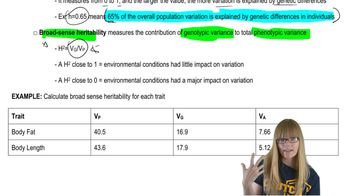
Broad Sense Heritability
Fraction of phenotypic variance attributed to all genetic variance, including additive and dominance effects.
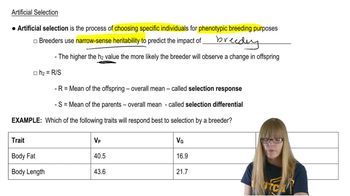
Narrow Sense Heritability
Fraction of phenotypic variance due to additive genetic variance, crucial for predicting response to selection.
Additive Genetic Variance
Genetic variance resulting from differences between alleles, such as dominant and recessive, influencing trait inheritance.
Dominance Genetic Variance
Genetic variance caused by heterozygotes not being intermediates, affecting trait expression beyond simple allele addition.
Phenotypic Variance
Total observed variation in a trait within a population, resulting from both genetic and environmental factors.
Artificial Selection
Process where individuals with desired traits are chosen for breeding to enhance specific phenotypes in future generations.
Selection Response
Difference between the mean trait value of offspring and the original population, reflecting effectiveness of selection.
Selection Differential
Difference between the mean trait value of selected parents and the original population, indicating selection intensity.
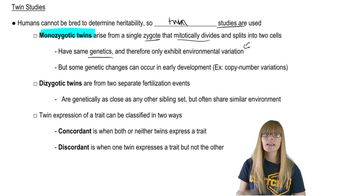
Monozygotic Twins
Siblings originating from a single zygote that splits, resulting in nearly identical genetic makeup.
Dizygotic Twins
Siblings from two separate eggs fertilized by two sperm, sharing genetic similarity equivalent to regular siblings.
Concordant Trait
Trait expressed or not expressed by both twins in a pair, indicating shared genetic or environmental influence.
Discordant Trait
Trait expressed by only one twin in a pair, highlighting differences in genetic expression or environmental impact.
Copy Number Variance
Genetic variation due to differences in the number of copies of a particular DNA segment, even among identical twins.
 BackBack

 07:04
07:04