Skip to main content
Genetics
My Course
Learn
Exam Prep
AI Tutor
Study Guides
Textbook Solutions
Flashcards
Explore
Try the app
My Course
Learn
Exam Prep
AI Tutor
Study Guides
Textbook Solutions
Flashcards
Explore
Try the app
Back
Lambda Bacteriophage and Life Cycle Regulation definitions
You can tap to flip the card.
Lambda Bacteriophage
You can tap to flip the card.
👆
Lambda Bacteriophage
A virus that infects bacteria, serving as a model for studying viral life cycle regulation between active and dormant states.
Track progress
Control buttons has been changed to "navigation" mode.
1/15
Related flashcards
Related practice
Recommended videos
Lambda Bacteriophage and Life Cycle Regulation quiz
Lambda Bacteriophage and Life Cycle Regulation
15 Terms
Lambda Bacteriophage and Life Cycle Regulation
12. Gene Regulation in Prokaryotes
4 problems
Topic
Kylia
Arabinose Operon
12. Gene Regulation in Prokaryotes
3 problems
Topic
Kylia
12. Gene Regulation in Prokaryotes
5 topics
10 problems
Chapter
Kylia
Guided course
04:29
Bacteriophage Life Cycle
1128
views
11
rank
Guided course
08:04
Decision Between Lytic and Lysogenic Cycles
771
views
5
rank
Guided course
05:34
Bacteriophage Regulation
845
views
8
rank
Terms in this set (15)
Hide definitions
Lambda Bacteriophage
A virus that infects bacteria, serving as a model for studying viral life cycle regulation between active and dormant states.
Lytic Cycle
A phase where viral replication is active, leading to cell bursting and release of new viral particles.
Lysogenic Cycle
A dormant phase where viral DNA integrates into the host genome and remains inactive until triggered.
Cro Protein
A regulatory molecule that, when abundant, suppresses lysogenic genes and promotes active viral replication.
CI Protein
A regulatory molecule, also called lambda repressor, that promotes dormancy by inhibiting lytic gene expression.
C2 Protein
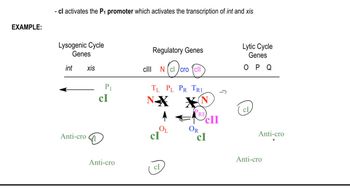
A factor that activates the PRE promoter, leading to production of proteins favoring the lysogenic state.
N Protein
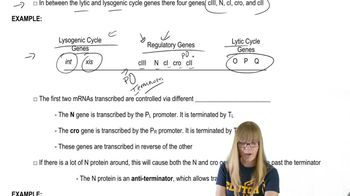
An anti-terminator that enables transcription to proceed past terminators, allowing expression of downstream genes.
Operator
A DNA region where regulatory proteins bind to control transcription of adjacent genes.
Promoter
A DNA sequence where RNA polymerase initiates transcription of a gene.
Terminator
A DNA sequence signaling the end of transcription, which can be bypassed by anti-terminator proteins.
Protease
An enzyme that degrades regulatory proteins like C2, influencing the choice between viral life cycles.
PRE Promoter
A regulatory DNA element activated by C2, leading to synthesis of proteins that suppress lytic genes.
Anti-Cro
A product transcribed from the PRE promoter that counteracts Cro protein, supporting lysogenic maintenance.
Regulatory Gene
A gene encoding a product that modulates the expression of other genes, crucial for life cycle decisions.
Growth Conditions
Environmental factors, such as nutrient availability, that influence viral regulatory protein levels and life cycle choice.
 BackBack
 04:29
04:29