Skip to main content
Genetics
My Course
Learn
Exam Prep
AI Tutor
Study Guides
Textbook Solutions
Flashcards
Explore
Try the app
My Course
Learn
Exam Prep
AI Tutor
Study Guides
Textbook Solutions
Flashcards
Explore
Try the app
Back
Mapping Genes definitions
You can tap to flip the card.
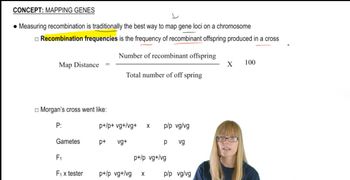
Recombination Frequency
You can tap to flip the card.
👆
Recombination Frequency
Percentage value representing how often recombinant offspring appear, directly correlating with gene distance on a chromosome.
Track progress
Control buttons has been changed to "navigation" mode.
1/15
Related flashcards
Related practice
Recommended videos
Mapping Genes quiz
Mapping Genes
15 Terms
Mapping Genes
4. Genetic Mapping and Linkage
7 problems
Topic
Kylia
Trihybrid Cross
4. Genetic Mapping and Linkage
7 problems
Topic
Kylia
4. Genetic Mapping and Linkage - Part 1 of 2
4 topics
11 problems
Chapter
Kylia
4. Genetic Mapping and Linkage - Part 2 of 2
5 topics
10 problems
Chapter
Kylia
Guided course
09:09
Mapping Genes
3649
views
34
rank
5
comments
Guided course
03:04
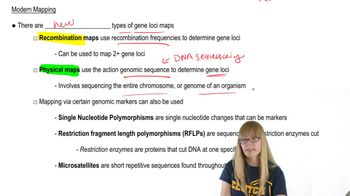
Modern Mapping
2406
views
16
rank
Terms in this set (15)
Hide definitions
Recombination Frequency
Percentage value representing how often recombinant offspring appear, directly correlating with gene distance on a chromosome.
Map Distance
Measurement, often in map units, indicating the physical separation between genes based on recombination data.
Map Unit
Unit equivalent to a 1% recombination frequency, used to express genetic distances between loci.
Parental Type
Offspring whose phenotype matches one of the original parents in a genetic cross.
Recombinant Type
Offspring displaying new combinations of traits not seen in either parent, resulting from genetic recombination.
Genetic Linkage
Condition where genes located close together on a chromosome tend to be inherited together due to low recombination.
Independent Assortment
Mendelian principle stating that genes on different chromosomes segregate into gametes independently.
Physical Map
Gene mapping approach using DNA sequencing to pinpoint exact nucleotide positions of genes on chromosomes.
Genomic Sequencing
Technique for determining the precise order of nucleotides in an organism’s DNA, enabling physical gene mapping.
Single Nucleotide Polymorphism
Genomic marker involving a single base change, useful for locating genes and studying genetic variation.
Restriction Fragment Length Polymorphism
Variation in DNA sequence detected by restriction enzyme cuts, serving as a marker for gene mapping.
Microsatellite
Short, repetitive DNA sequence scattered throughout the genome, valuable for identifying gene locations.
Crossover
Exchange of genetic material between homologous chromosomes, leading to new allele combinations in offspring.
Tester
Individual with a known genotype used in crosses to reveal the genotype of another organism.
Homozygous
Genetic condition where both alleles at a locus are identical, either dominant or recessive.
 BackBack
 09:09
09:09