What is the main advantage of mapping with markers compared to traditional linkage mapping?
Mapping with markers allows linking chromosomal regions without needing to link alleles or phenotypes, making it practical and ethical for humans.
What is a molecular marker in genetics?
A molecular marker is a DNA segment with a unique, identifiable property that is polymorphic and varies between individuals.
Why are molecular markers useful for mapping unknown genes?
They allow identification of gene locations without needing to know the phenotypes or alleles involved.
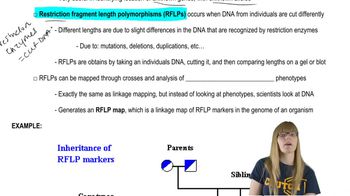
What does RFLP stand for?
RFLP stands for Restriction Fragment Length Polymorphism.
How do restriction enzymes contribute to RFLP mapping?
Restriction enzymes cut DNA at specific sequences, and sequence variations cause different cutting patterns, resulting in fragments of varying lengths.
What causes the differences in fragment lengths in RFLP analysis?
Differences in DNA sequence, such as mutations or single nucleotide polymorphisms, cause restriction enzymes to cut DNA differently.
How are RFLPs visualized and analyzed?
RFLPs are visualized by running the cut DNA on a gel, which separates fragments by length for comparison.
What is an RFLP map?
An RFLP map is a linkage map of molecular markers based on DNA sequence variations rather than phenotypic traits.
How can RFLP genotypes be determined from gel bands?
Homozygous dominant shows one band, homozygous recessive shows another, and heterozygous shows both bands on the gel.
What are microsatellites in the context of genetic mapping?
Microsatellites are repetitive DNA sequences, such as CA repeats, that vary in length and position between individuals.
How are microsatellites identified experimentally?
Microsatellites can be identified using techniques like PCR, Southern blotting, and DNA microarrays.
Why are microsatellites useful as molecular markers?
Their variable length and position among individuals make them useful for mapping and identifying genetic differences.
How is recombination frequency used in mapping with markers?
Recombination frequency from matings is used to determine the chromosomal position of markers, similar to traditional linkage mapping.
What is the key difference between traditional linkage mapping and mapping with markers?
Traditional linkage mapping uses phenotypes, while mapping with markers uses DNA sequence positions and lengths.
Can mapping with markers be used in humans, and why?
Yes, because it does not require forced matings or tracking phenotypes, making it ethical and practical for human studies.
 Back
Back

 07:11
07:11