Skip to main content
Genetics
My Course
Learn
Exam Prep
AI Tutor
Study Guides
Textbook Solutions
Flashcards
Explore
Try the app
My Course
Learn
Exam Prep
AI Tutor
Study Guides
Textbook Solutions
Flashcards
Explore
Try the app
Back
Modern Genetics definitions
You can tap to flip the card.
Mutation
You can tap to flip the card.
👆
Mutation
A change in the genetic sequence, often responsible for new traits or diseases, and a major focus in current genetic research.
Track progress
Control buttons has been changed to "navigation" mode.
1/15
Related flashcards
Related practice
Recommended videos
Modern Genetics quiz #1
Modern Genetics
13 Terms
Modern Genetics
1. Introduction to Genetics
7 problems
Topic
Kylia
Fundamentals of Genetics
1. Introduction to Genetics
7 problems
Topic
Kylia
1. Introduction to Genetics
3 topics
9 problems
Chapter
Kylia
Guided course
09:03
Modern Genetics
3399
views
73
rank
Terms in this set (15)
Hide definitions
Mutation
A change in the genetic sequence, often responsible for new traits or diseases, and a major focus in current genetic research.
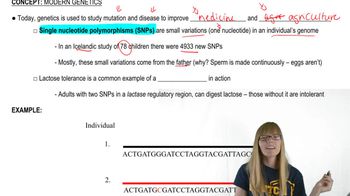
Single Nucleotide Polymorphism
A variation at a single position in DNA among individuals, often influencing traits like lactose tolerance.
Genome
The complete set of genetic material in an organism, where variations and mutations are studied.
Lactase Gene
A DNA segment responsible for producing an enzyme that enables digestion of milk sugar beyond infancy.
Biotechnology
The manipulation of biological systems for industrial or medical purposes, such as enhancing crops or producing medicines.
Golden Rice
A genetically modified crop enriched with beta-carotene to address vitamin A deficiencies in human diets.
Gene Therapy
A clinical approach involving the introduction of functional genes to correct or alleviate genetic disorders.
Proteomics
The comprehensive study of all proteins in a cell, revealing how protein composition changes under different conditions.
Bioinformatics
The use of computational tools to analyze and manage large-scale genetic, protein, and RNA data.
Model Organism
A species, such as fruit flies or mice, widely used in laboratories to investigate genetic principles.
Variation
Genetic differences among individuals, often arising from mutations and crucial for studying traits and diseases.
Beta-Carotene
A nutrient precursor to vitamin A, engineered into crops like rice to improve nutritional value.
Enzyme
A protein that accelerates biochemical reactions, such as breaking down lactose in the digestive system.
Trait
A characteristic or feature of an organism, often influenced by genetic variations like SNPs.
Offspring
The next generation resulting from parental reproduction, inheriting genetic variations and mutations.
 BackBack
 09:03
09:03