The main goal is to identify the specific gene responsible for a disease by analyzing a chromosome region associated with the disease phenotype.
What is the first step in positional cloning?
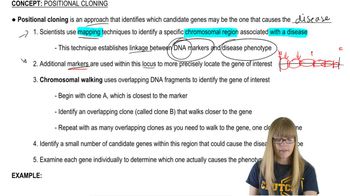
The first step is to use traditional mapping techniques, such as pedigrees or laboratory crosses, to identify the chromosome region linked to the disease.
How are DNA markers used in positional cloning?
DNA markers are used to divide the identified chromosome region into smaller segments to help narrow down the location of the disease-causing gene.
What is chromosome walking?
Chromosome walking is a technique that uses overlapping DNA fragments from a genomic library to progressively narrow in on the gene of interest.
Why is mapping recombination frequencies important in positional cloning?
Mapping recombination frequencies helps determine which chromosomal region between DNA markers is likely to contain the gene responsible for the disease.
What is a genomic library in the context of positional cloning?
A genomic library is a collection of short, overlapping DNA fragments from the genome, used to find and analyze specific regions during chromosome walking.
How does positional cloning narrow down from the whole genome to a single gene?
It starts with broad mapping to identify a region, then uses DNA markers and chromosome walking to focus on smaller regions, eventually isolating the candidate gene(s).
What is the role of pedigrees in human positional cloning?
Pedigrees are used to analyze inheritance patterns and recombination events to map the chromosome region associated with a disease in humans.
After narrowing down to a small region, what is the next step in positional cloning?
The next step is to analyze the small group of candidate genes within the region to determine which one is associated with the disease phenotype.
Why might the initial mapped region contain many genes?
The initial mapping may only localize the disease gene to a broad region, which can include hundreds of genes before further narrowing is done.
How are candidate genes evaluated in the final steps of positional cloning?
Candidate genes are examined for their expression patterns and potential association with the disease phenotype to identify the causative gene.
What is the significance of overlapping DNA fragments in chromosome walking?
Overlapping fragments allow researchers to move stepwise along the chromosome, ensuring continuous coverage and precise localization of the gene.
How does positional cloning differ in humans compared to model organisms?
In humans, researchers use pedigrees instead of controlled crosses, since human crosses cannot be performed experimentally.
What is the ultimate outcome of positional cloning?
The ultimate outcome is the identification of the specific gene responsible for a disease, starting from a broad chromosomal region.
Why is positional cloning described as a step-by-step process?
It involves sequential narrowing from the entire genome to a specific gene using mapping, DNA markers, and chromosome walking.
 Back
Back

 07:
07: