Skip to main content
Genetics
My Course
Learn
Exam Prep
AI Tutor
Study Guides
Textbook Solutions
Flashcards
Explore
Try the app
My Course
Learn
Exam Prep
AI Tutor
Study Guides
Textbook Solutions
Flashcards
Explore
Try the app
Back
Post Translational Modifications definitions
You can tap to flip the card.
Post-translational Modification
You can tap to flip the card.
👆
Post-translational Modification
Chemical or structural changes to proteins after synthesis, altering their function, location, or stability to regulate gene expression.
Track progress
Control buttons has been changed to "navigation" mode.
1/14
Related flashcards
Related practice
Recommended videos
Post Translational Modifications quiz
Post Translational Modifications
15 Terms
Post Translational Modifications
13. Gene Regulation in Eukaryotes
4 problems
Topic
Kylia
Epigenetics, Chromatin Modifications, and Regulation
13. Gene Regulation in Eukaryotes
7 problems
Topic
Kylia
13. Gene Regulation in Eukaryotes
4 topics
11 problems
Chapter
Kylia
Guided course
04:30
Post Translational Modifications
1181
views
14
rank
Terms in this set (14)
Hide definitions
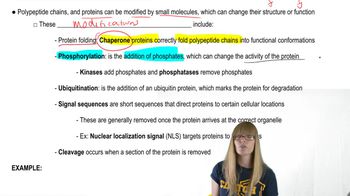
Post-translational Modification
Chemical or structural changes to proteins after synthesis, altering their function, location, or stability to regulate gene expression.
Phosphorylation
Attachment of phosphate groups to amino acids, often activating or deactivating proteins and influencing gene expression.
Ubiquitination
Attachment of ubiquitin molecules to proteins, marking them for degradation and thus controlling protein levels in the cell.
Cleavage
Proteolytic removal of protein segments, which can initiate signaling cascades or alter protein function dramatically.
Signal Sequence
Short peptide motif within a protein that directs its transport to specific cellular compartments, such as the nucleus.
Chaperone Protein
Molecule that assists in the correct folding of polypeptide chains, ensuring proper protein structure and function.
Kinase
Enzyme responsible for adding phosphate groups to proteins, typically modulating their activity.
Phosphatase
Enzyme that removes phosphate groups from proteins, often reversing the effects of kinases.
Nuclear Localization Signal
Amino acid sequence within a protein that targets it for import into the nucleus, crucial for nuclear protein function.
Protein Degradation
Process by which proteins are broken down, often following ubiquitination, to regulate cellular protein levels.
Polypeptide Chain
Linear sequence of amino acids that folds into a functional protein, subject to various post-translational modifications.
Substrate
Molecule upon which enzymes such as kinases or ubiquitin ligases act during post-translational modifications.
Gene Expression
Overall process by which genetic information is used to synthesize functional proteins, modulated at multiple levels including post-translation.
Phenotype
Observable characteristics of an organism, which can be altered by changes in protein function due to post-translational modifications.
 BackBack
 04:30
04:30