Skip to main content
Genetics
My Course
Learn
Exam Prep
AI Tutor
Study Guides
Textbook Solutions
Flashcards
Explore
Try the app
My Course
Learn
Exam Prep
AI Tutor
Study Guides
Textbook Solutions
Flashcards
Explore
Try the app
Back
Post Translational Modifications quiz
You can tap to flip the card.
What are post-translational modifications?
You can tap to flip the card.
👆
What are post-translational modifications?
They are changes made to proteins after they are synthesized, altering their structure or function to regulate gene expression.
Track progress
Control buttons has been changed to "navigation" mode.
1/15
Related flashcards
Related practice
Recommended videos
Post Translational Modifications definitions
Post Translational Modifications
14 Terms
Post Translational Modifications
13. Gene Regulation in Eukaryotes
4 problems
Topic
Kylia
Epigenetics, Chromatin Modifications, and Regulation
13. Gene Regulation in Eukaryotes
7 problems
Topic
Kylia
13. Gene Regulation in Eukaryotes
4 topics
11 problems
Chapter
Kylia
Guided course
04:30
Post Translational Modifications
1181
views
14
rank
Terms in this set (15)
Hide definitions
What are post-translational modifications?
They are changes made to proteins after they are synthesized, altering their structure or function to regulate gene expression.
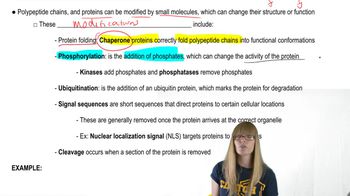
How do chaperone proteins contribute to post-translational regulation?
Chaperone proteins help fold polypeptide chains correctly, ensuring proteins achieve the proper structure for their function.
What is phosphorylation in the context of post-translational modification?
Phosphorylation is the addition of phosphate groups to proteins, usually activating or deactivating them.
Which enzymes add and remove phosphate groups during phosphorylation?
Kinases add phosphate groups, while phosphatases remove them.
How does phosphorylation typically affect protein activity?
It usually activates proteins, but in some cases, it can inactivate them.
What is ubiquitination and what is its main effect on proteins?
Ubiquitination is the addition of ubiquitin proteins to a target protein, marking it for degradation.
How does ubiquitination impact gene expression?
By marking proteins for degradation, it removes proteins that are no longer needed, thus affecting gene regulation.
What are signal sequences and what is their role?
Signal sequences are short peptide sequences that direct proteins to specific cellular locations, such as the nucleus.
What happens to a protein's signal sequence once it reaches its destination?
The signal sequence is typically removed, allowing the protein to function in its new location.
What is the nuclear localization signal?
It is a specific amino acid sequence that directs a protein to the nucleus.
How can cleavage modify a protein's function?
Cleavage cuts sections off a protein, which can change its function or initiate a cascade of cellular events.
Why is protein folding important for gene expression?
Proper folding ensures proteins are functional; misfolded proteins are destroyed and cannot contribute to gene expression.
Can a protein be phosphorylated more than once?
Yes, a protein can be phosphorylated at multiple sites, sometimes hundreds or thousands of times.
What happens to gene expression if a protein is degraded after ubiquitination?
Gene expression is affected because the degraded protein can no longer perform its function.
How do post-translational modifications regulate gene expression after translation?
They alter protein activity, location, or stability, thereby influencing whether and how a gene's product functions in the cell.
 BackBack
 04:30
04:30