Skip to main content
Genetics
My Course
Learn
Exam Prep
AI Tutor
Study Guides
Textbook Solutions
Flashcards
Explore
Try the app
My Course
Learn
Exam Prep
AI Tutor
Study Guides
Textbook Solutions
Flashcards
Explore
Try the app
Back
Proteins definitions
You can tap to flip the card.
Amino Acid
You can tap to flip the card.
👆
Amino Acid
Building block with a unique R group, amino group, and carboxyl group, determining protein properties and structure.
Track progress
Control buttons has been changed to "navigation" mode.
1/15
Related flashcards
Related practice
Recommended videos
Proteins quiz #1
Proteins
10 Terms
Proteins
11. Translation
7 problems
Topic
Kylia
Translation
11. Translation
7 problems
Topic
Kylia
11. Translation
5 topics
13 problems
Chapter
Kylia
Guided course
05:05
Proteins
1650
views
14
rank
1
comments
Terms in this set (15)
Hide definitions
Amino Acid
Building block with a unique R group, amino group, and carboxyl group, determining protein properties and structure.
Polypeptide Chain
Linear sequence of amino acids linked together, forming the backbone of protein structure.
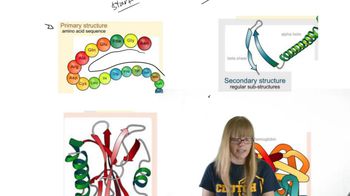
Primary Structure
Specific order of amino acids in a chain, dictating all higher levels of protein organization.
Secondary Structure
Local folding patterns like alpha helices and beta sheets, stabilized by interactions between nearby residues.
Alpha Helix
Spiral-shaped local structure within a protein, stabilized by hydrogen bonds between backbone atoms.
Beta Sheet
Sheet-like arrangement formed by aligned polypeptide strands, which can be parallel or antiparallel.
Tertiary Structure
Overall 3D shape of a single polypeptide chain, integrating multiple secondary structures.
Quaternary Structure
Three-dimensional arrangement of multiple polypeptide chains, contributing to protein function.
N-terminus
Start of a polypeptide chain, marked by a free amino group.
C-terminus
End of a polypeptide chain, marked by a free carboxyl group.
R Group
Variable side chain of an amino acid, responsible for its unique chemical properties.
Globular Protein
Compact, roughly spherical protein shape, often associated with dynamic biological functions.
Fibrous Protein
Elongated, linear protein shape, typically providing structural support.
Domain
Distinct structural region within a protein, often associated with a specific function.
Chaperone
Helper molecule ensuring correct protein folding, preventing misfolding or aggregation.
 BackBack
 05:05
05:05