A quantitative trait is a complex trait controlled by multiple genes and can be measured on a continuous scale.
What does 'loci' mean in the context of QTL mapping?
Loci refers to the locations of genes on the genome.
What is the main purpose of QTL mapping?
QTL mapping aims to identify the locations of genes responsible for quantitative traits in the genome.
Why are inbred lines used in QTL mapping experiments?
Inbred lines are used because they are genetically identical, allowing for controlled crosses and clearer genetic analysis.
What is a backcross in QTL mapping, and why is it performed?
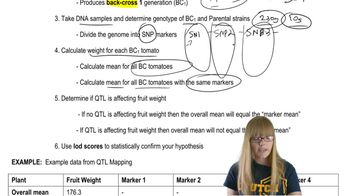
A backcross involves mating the F1 generation with a parent to produce the BC1 generation, which is used for genetic analysis.
What are SNPs and why are they important in QTL mapping?
SNPs (Single Nucleotide Polymorphisms) are genetic markers used to map the genome and identify regions associated with traits.
How is the presence of a QTL at a specific SNP determined?
If the mean trait value at a specific SNP differs significantly from the overall mean, a QTL is likely present at that location.
What statistical method is commonly used to confirm QTL presence?
LOD scores (logarithm of odds) are used to statistically confirm the presence of QTLs.
What is fine mapping in QTL studies?
Fine mapping is a method used to pinpoint the specific gene within a large genomic region identified as a QTL.
What are nearly isogenic lines and how are they used in fine mapping?
Nearly isogenic lines are genetically identical except for small regions due to crossover events, helping to identify the exact gene responsible for a trait.
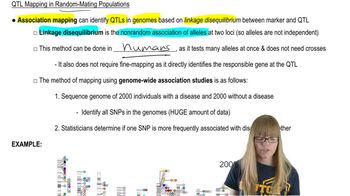
What is association mapping and how does it differ from traditional QTL mapping?
Association mapping is used in random mating populations and relies on linkage disequilibrium, not controlled crosses, to identify gene locations.
What is linkage disequilibrium in the context of association mapping?
Linkage disequilibrium is the non-random association of alleles, meaning certain alleles are found together more often than expected by chance.
What is a genome-wide association study (GWAS)?
GWAS is a method that compares SNP frequencies between affected and unaffected individuals to identify genes associated with complex traits or diseases.
Why is GWAS important for studying human diseases?
GWAS allows researchers to identify genes responsible for complex traits and diseases in humans without needing controlled crosses.
How does QTL mapping help in understanding polygenic traits?
QTL mapping identifies the locations of multiple genes contributing to polygenic traits, enabling researchers to study their genetic basis.
 Back
Back

 13:26
13:26