Skip to main content
Genetics
My Course
Learn
Exam Prep
AI Tutor
Study Guides
Textbook Solutions
Flashcards
Explore
Try the app
My Course
Learn
Exam Prep
AI Tutor
Study Guides
Textbook Solutions
Flashcards
Explore
Try the app
Back
RNA Interference definitions
You can tap to flip the card.
RNA Interference
You can tap to flip the card.
👆
RNA Interference
A cellular process using RNA molecules to prevent specific transcripts from being translated into proteins, acting after transcription.
Track progress
Control buttons has been changed to "navigation" mode.
1/13
Related flashcards
Related practice
Recommended videos
RNA Interference quiz #1
RNA Interference
12 Terms
RNA Interference
10. Transcription
4 problems
Topic
Kylia
RNA Modification and Processing
10. Transcription
6 problems
Topic
Kylia
10. Transcription
5 topics
15 problems
Chapter
Kylia
Guided course
06:59
RNA Interference
1765
views
17
rank
Terms in this set (13)
Hide definitions
RNA Interference
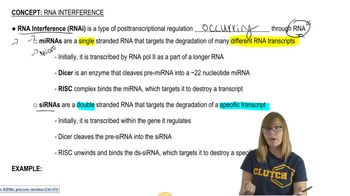
A cellular process using RNA molecules to prevent specific transcripts from being translated into proteins, acting after transcription.
Post-Transcriptional Regulation
A control mechanism that modifies or inhibits RNA transcripts after they are made but before they are translated into proteins.
MicroRNA
A single-stranded RNA, about 22 nucleotides long, that can target and inhibit multiple different RNA transcripts.
Short Interfering RNA
A double-stranded RNA processed into a single strand, specifically targeting one RNA transcript for inhibition.
Dicer
An enzyme that processes precursor RNAs by cleaving them into short, functional RNA segments of about 22 nucleotides.
RISC
A protein complex that binds processed RNA molecules, guiding them to complementary transcripts for degradation.
Complementary Base Pairing
A molecular interaction where RNA nucleotides align with matching bases on target transcripts, enabling specific binding.
Non-Coding Region
A segment of a gene, such as an intron, that does not code for protein but can give rise to regulatory RNAs.
Intron
A non-coding sequence within a gene that is removed during RNA processing and can contain regulatory RNA elements.
Pre-microRNA
An initial, longer RNA molecule that is processed by Dicer to produce a mature, functional microRNA.
Hairpin Loop
A secondary RNA structure formed when a single strand folds back on itself, often seen in siRNA precursors.
Guide Strand
The remaining single RNA strand after processing, which directs the RISC complex to complementary target transcripts.
Transcript Degradation
The process by which targeted RNA molecules are broken down, preventing their translation into proteins.
 BackBack
 06:59
06:59