Skip to main content
Genetics
My Course
Learn
Exam Prep
AI Tutor
Study Guides
Textbook Solutions
Flashcards
Explore
Try the app
My Course
Learn
Exam Prep
AI Tutor
Study Guides
Textbook Solutions
Flashcards
Explore
Try the app
Back
RNA Modification and Processing definitions
You can tap to flip the card.
5' Cap
You can tap to flip the card.
👆
5' Cap
A methylguanosine structure added to the RNA's start, protecting it from degradation and aiding in translation initiation.
Track progress
Control buttons has been changed to "navigation" mode.
1/15
Related flashcards
Related practice
Recommended videos
RNA Modification and Processing quiz #1
RNA Modification and Processing
15 Terms
RNA Modification and Processing
10. Transcription
6 problems
Topic
Kylia
RNA Interference
10. Transcription
4 problems
Topic
Kylia
10. Transcription
5 topics
15 problems
Chapter
Kylia
Guided course
08:39
mRNA Processing
2365
views
26
rank
2
comments
Terms in this set (15)
Hide definitions
5' Cap
A methylguanosine structure added to the RNA's start, protecting it from degradation and aiding in translation initiation.
Polyadenylation Tail
A stretch of 150-200 adenine nucleotides at the RNA's end, enhancing stability and export from the nucleus.
Polyadenylation Signal
A specific AAUAAA sequence in RNA that triggers the addition of the polyadenylation tail.
Spliceosome
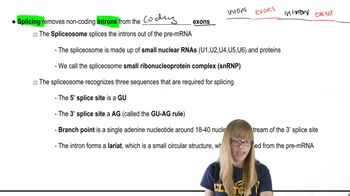
A complex of small nuclear RNAs and proteins responsible for removing introns from pre-mRNA.
Small Nuclear RNA
RNA molecules, such as U1, U2, U4, U5, and U6, that combine with proteins to form the spliceosome.
SNRNP
A small ribonuclear protein complex formed by small nuclear RNAs and proteins, essential for splicing.
Intron
A non-coding segment within pre-mRNA that is removed during splicing.
Exon
A coding segment of RNA that remains after splicing and is joined to form mature mRNA.
5' Splice Site
A GU nucleotide sequence marking the start of an intron, recognized during splicing.
3' Splice Site
An AG nucleotide sequence marking the end of an intron, essential for accurate splicing.
Branch Point
A single adenine nucleotide, typically 18-40 bases upstream of the 3' splice site, crucial for lariat formation.
Lariat
A looped structure formed by the excised intron during splicing, which is later degraded.
Alternative Splicing
A process generating multiple mRNA variants from one gene by combining exons in different ways.
RNA Editing
A post-transcriptional modification involving nucleotide substitution, insertion, or deletion in RNA.
Guide RNA
A molecule that directs where RNA editing occurs by base-pairing with the target RNA sequence.
 BackBack
 08:39
08:39