Skip to main content
Genetics
My Course
Learn
Exam Prep
AI Tutor
Study Guides
Textbook Solutions
Flashcards
Explore
Try the app
My Course
Learn
Exam Prep
AI Tutor
Study Guides
Textbook Solutions
Flashcards
Explore
Try the app
Back
Traits and Variance definitions
You can tap to flip the card.
Continuous Trait
You can tap to flip the card.
👆
Continuous Trait
A characteristic that can assume any value within a range, often measured with decimals, like human height or weight.
Track progress
Control buttons has been changed to "navigation" mode.
1/14
Related flashcards
Related practice
Recommended videos
Traits and Variance quiz #1
Traits and Variance
15 Terms
Traits and Variance
20. Quantitative Genetics
7 problems
Topic
Kylia
Analyzing Trait Variance
20. Quantitative Genetics
7 problems
Topic
Kylia
20. Quantitative Genetics
5 topics
14 problems
Chapter
Nicole
Guided course
13:40
Traits and Variance
1152
views
5
rank
1
comments
Terms in this set (14)
Hide definitions
Continuous Trait
A characteristic that can assume any value within a range, often measured with decimals, like human height or weight.
Categorical Trait
A characteristic sorted into distinct groups, with no intermediate values, such as flower color or Dalmatian spots.
Threshold Trait
A characteristic expressed only when a combination of genetic and environmental factors surpasses a specific limit.
Counting Trait
A characteristic measured in whole numbers, never fractions, like the number of eggs a bird lays.
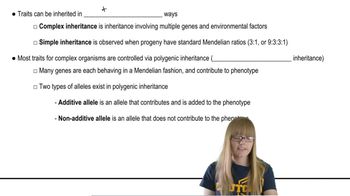
Complex Inheritance
A pattern involving multiple genes or environmental influences, often resulting in a wide range of phenotypes.
Simple Inheritance
A pattern involving a single gene, typically following Mendelian ratios such as 3:1 or 9:3:3:1.
Polygenic Inheritance
A pattern where multiple genes contribute additively or non-additively to a single phenotype, creating variation.
Additive Allele
A gene variant that increases the effect on a phenotype, with each copy contributing to the trait's expression.
Non-Additive Allele
A gene variant that does not contribute to the phenotype, even when present in the genotype.
Phenotypic Category
A distinct observable group resulting from genetic combinations, calculated using specific formulas in polygenic traits.
Mendelian Ratio
A predictable proportion of offspring phenotypes, such as 3:1, seen in simple inheritance patterns.
F2 Generation
The group of offspring resulting from crossing two F1 individuals, often showing a range of phenotypes in polygenic traits.
Parental Phenotype
The observable traits of the original organisms used in a genetic cross, used as a reference in inheritance studies.
Genetic Formula
A mathematical expression used to determine gene count or phenotype number, such as '1/4^n' or '2n+1'.
 BackBack

 13:40
13:40