Skip to main content
Genetics
My Course
Learn
Exam Prep
AI Tutor
Study Guides
Textbook Solutions
Flashcards
Explore
Try the app
My Course
Learn
Exam Prep
AI Tutor
Study Guides
Textbook Solutions
Flashcards
Explore
Try the app
Back
Transposable Elements in Eukaryotes definitions
You can tap to flip the card.
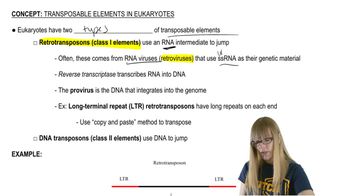
Retrotransposon
You can tap to flip the card.
👆
Retrotransposon
A genetic element that moves via an RNA intermediate, requiring reverse transcription before integrating into new genomic locations.
Track progress
Control buttons has been changed to "navigation" mode.
1/15
Related flashcards
Related practice
Recommended videos
Transposable Elements in Eukaryotes quiz #1
Transposable Elements in Eukaryotes
10 Terms
Transposable Elements in Eukaryotes
16. Transposable Elements
7 problems
Topic
Kylia
Regulation of Transposable Elements
16. Transposable Elements
3 problems
Topic
Nicole
16. Transposable Elements
4 topics
8 problems
Chapter
Kylia
Guided course
05:30
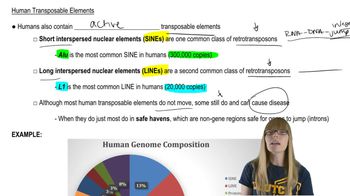
Human Transposable Elements
916
views
5
rank
Guided course
03:08
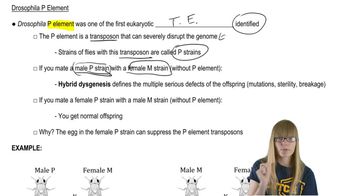
Drosophila P Element
1212
views
6
rank
Guided course
03:14
Eukaryotic Transposable Elements
1284
views
7
rank
Terms in this set (15)
Hide definitions
Retrotransposon
A genetic element that moves via an RNA intermediate, requiring reverse transcription before integrating into new genomic locations.
DNA Transposon
A mobile genetic sequence that relocates directly as DNA, often using a cut-and-paste mechanism within the genome.
Reverse Transcriptase
An enzyme responsible for synthesizing DNA from an RNA template, enabling certain genetic elements to integrate into genomes.
Long Terminal Repeat
A repeated DNA sequence found at both ends of some retrotransposons, crucial for their integration and replication.
P Element
A DNA transposon in fruit flies that can disrupt genes, leading to mutations and sterility in specific genetic crosses.
Hybrid Dysgenesis
A syndrome in fruit fly offspring marked by mutations, sterility, and chromosomal breakage due to active transposon movement.
SINE
A short, non-coding retrotransposon abundant in the human genome, with ALU being the most prevalent type.
LINE
A long, autonomous retrotransposon in humans, with L1 elements being the most active and numerous.
ALU
A highly repetitive SINE in humans, present in hundreds of thousands of copies, capable of occasional genomic movement.
L1
A LINE element in humans, present in tens of thousands of copies, some of which remain capable of transposition.
Safe Haven
A genomic region, such as an intron, where transposable elements can insert without disrupting gene function.
Chromosomal Rearrangement
A structural alteration in chromosomes, often caused by transposon activity, that can impact gene expression and evolution.
Provirus
A DNA sequence derived from a virus that has integrated into a host genome, often as a result of retrotransposon evolution.
Transposase
A protein that catalyzes the movement of DNA transposons, enabling their excision and reintegration within the genome.
Gene Regulation
The modulation of gene activity, which can be influenced by transposable elements inserting near or within regulatory regions.
 BackBack

 05:30
05:30