Skip to main content
Genetics
My Course
Learn
Exam Prep
AI Tutor
Study Guides
Textbook Solutions
Flashcards
Explore
Try the app
My Course
Learn
Exam Prep
AI Tutor
Study Guides
Textbook Solutions
Flashcards
Explore
Try the app
Back
Transposable Elements in Prokaryotes definitions
You can tap to flip the card.
Transposable Element
You can tap to flip the card.
👆
Transposable Element
A DNA sequence capable of moving to new positions within the genome, impacting genetic variability and adaptation.
Track progress
Control buttons has been changed to "navigation" mode.
1/13
Related flashcards
Related practice
Recommended videos
Transposable Elements in Prokaryotes quiz
Transposable Elements in Prokaryotes
15 Terms
Transposable Elements in Prokaryotes
16. Transposable Elements
3 problems
Topic
Nicole
Transposable Elements in Eukaryotes
16. Transposable Elements
7 problems
Topic
Kylia
16. Transposable Elements
4 topics
8 problems
Chapter
Kylia
Guided course
06:10
Prokaryotic Transposable Elements
1213
views
9
rank
Terms in this set (13)
Hide definitions
Transposable Element
A DNA sequence capable of moving to new positions within the genome, impacting genetic variability and adaptation.
Insertion Sequence
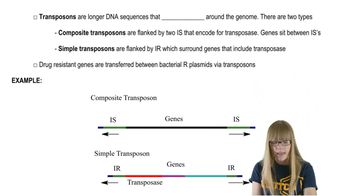
A short bacterial DNA segment flanked by inverted repeats and encoding transposase, enabling genomic mobility.
Transposon
A longer DNA segment that can relocate within the genome, often carrying additional genes such as those for drug resistance.
Composite Transposon
A mobile DNA unit flanked by two insertion sequences, which provide the transposase needed for movement.
Simple Transposon
A DNA segment bordered by inverted repeats and containing its own transposase gene, facilitating its movement.
Inverted Repeat
A sequence of nucleotides at each end of certain mobile elements, essential for their recognition and movement.
Transposase
An enzyme that catalyzes the movement of mobile DNA elements by recognizing specific repeat sequences.
Replicative Transposition
A mechanism where a mobile DNA element is copied, with the new copy relocating while the original remains.
Conservative Transposition
A process where a mobile DNA element is excised and inserted into a new site, maintaining a constant copy number.
Drug Resistance
A trait often spread among bacteria by mobile DNA elements, enabling survival against antibiotics.
Genome
The complete set of genetic material in a cell, subject to rearrangement by mobile DNA elements.
Superbug
A bacterium with high antibiotic resistance, often due to gene transfer via mobile DNA elements.
R Plasmid
A circular DNA molecule in bacteria that frequently carries mobile elements conferring antibiotic resistance.
 BackBack

 06:10
06:10