What are the two types of transposable elements found in prokaryotic cells?
The two types are insertion sequences and transposons.
What enzyme is required for the movement of transposable elements?
Transposase is the enzyme required for movement of transposable elements.
What structural features characterize an insertion sequence?
Insertion sequences have inverted repeat sequences at each end and a transposase gene encoded between these repeats.
Where is the transposase gene located in an insertion sequence?
The transposase gene is located between the inverted repeats in an insertion sequence.
How do composite transposons differ from simple transposons in terms of transposase encoding?
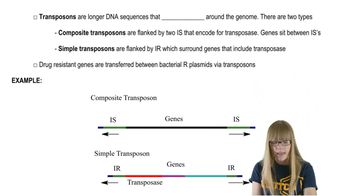
Composite transposons do not encode transposase themselves; instead, their flanking insertion sequences encode it, while simple transposons encode transposase within their own genes.
What flanks composite transposons?
Composite transposons are flanked by insertion sequences.
What flanks simple transposons?
Simple transposons are flanked by inverted repeats.
How are simple transposons similar to insertion sequences?
Both are flanked by inverted repeats and encode transposase, but simple transposons are generally longer.
What role do transposons play in bacterial drug resistance?
Transposons facilitate the transfer of resistance genes between bacteria, contributing to the emergence of 'superbugs'.
What are the two mechanisms by which transposons move within the genome?
Transposons move via replicative transposition (copy and paste) and conservative transposition (cut and paste).
What happens during replicative transposition?
The transposon is copied, and the new copy moves to a new location while the original remains, increasing the number of copies.
What happens during conservative transposition?
The transposon is cut from its original location and moved to a new location, keeping the number of copies the same.
How does the copy and paste method affect the number of transposon copies in the genome?
It increases the number of transposon copies because the original stays and a new copy is inserted elsewhere.
How does the cut and paste method affect the number of transposon copies in the genome?
The number of transposon copies remains the same; only the location changes.
Why are inverted repeats important in transposable elements?
Inverted repeats are required for the transposable element to be able to jump within the genome.
 Back
Back

 06:10
06:10