Skip to main content
Genetics
My Course
Learn
Exam Prep
AI Tutor
Study Guides
Textbook Solutions
Flashcards
Explore
Try the app
My Course
Learn
Exam Prep
AI Tutor
Study Guides
Textbook Solutions
Flashcards
Explore
Try the app
Back
Working with Microorganisms definitions
You can tap to flip the card.
E. Coli
You can tap to flip the card.
👆
E. Coli
A commonly used, non-pathogenic bacterial strain in labs, valued for rapid growth and genetic manipulation.
Track progress
Control buttons has been changed to "navigation" mode.
1/15
Related flashcards
Related practice
Recommended videos
Working with Microorganisms quiz #1
Working with Microorganisms
10 Terms
Working with Microorganisms
5. Genetics of Bacteria and Viruses
7 problems
Topic
Kylia
Bacterial Conjugation
5. Genetics of Bacteria and Viruses
7 problems
Topic
Kylia
5. Genetics of Bacteria and Viruses
5 topics
13 problems
Chapter
Kylia
Guided course
09:35
Bacteria in the Laboratory
1910
views
28
rank
2
comments
Terms in this set (15)
Hide definitions
E. Coli
A commonly used, non-pathogenic bacterial strain in labs, valued for rapid growth and genetic manipulation.
Plating
A technique where bacteria are spread on agar in a petri dish to grow isolated groups from single cells.
Agar
A firm, jelly-like substance in petri dishes that provides nutrients and a surface for bacterial growth.
Colony
A visible clump of genetically identical bacterial cells derived from a single ancestor on a solid medium.
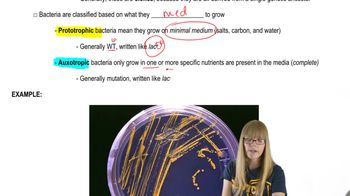
Prototroph
A wild-type bacterial strain capable of growing on minimal media without added nutrients.
Auxotroph
A mutant bacterial strain requiring specific nutrients in complete media due to metabolic deficiencies.
Minimal Media
A nutrient solution containing only essential salts, carbon, and water, supporting only wild-type bacterial growth.
Complete Media
A nutrient-rich solution containing all essentials plus extra nutrients needed by mutant bacteria.
Chromosome
The main DNA molecule in bacteria, housing essential genes for survival, growth, and division.
Plasmid
A small, circular DNA molecule in bacteria, separate from the chromosome, often carrying beneficial traits.
Antibiotic Resistance
A trait often encoded on plasmids, enabling bacteria to survive and grow in the presence of antibiotics.
Conjugation
A DNA transfer process involving direct contact and fusion between two bacterial cells.
Transformation
A process where bacteria take up free DNA from their environment, leading to genetic change.
Transduction
A DNA transfer method where a bacteriophage introduces genetic material into a bacterial cell.
Horizontal Transmission
The movement of genetic material between existing bacterial cells, not involving offspring.
 BackBack
 09:35
09:35