Pearson+ LogoPearson+ Logo
Ch. 15 - Regulation of Gene Expression in Bacteria
Klug - Essentials of Genetics 10th Edition
Klug10th EditionEssentials of GeneticsISBN: 9780135588789Not the one you use?Change textbook
Chapter 15, Problem 17

How does the molecular mechanism of the CRISPR-Cas system use a viral DNA sequence against that same virus?

Verified step by step guidance
1
Understand that the CRISPR-Cas system is an adaptive immune mechanism in bacteria and archaea that provides resistance against invading viruses (phages) by using sequences derived from the viral DNA itself.
Recognize that when a virus infects a bacterium, the CRISPR system captures a short segment of the viral DNA and integrates it into the bacterial genome at the CRISPR locus as a 'spacer' sequence between repeat sequences.
Learn that these spacer sequences are transcribed into CRISPR RNA (crRNA), which guides the Cas proteins to recognize and bind to the complementary viral DNA sequence during subsequent infections.
Know that the Cas proteins, guided by the crRNA, then cleave the matching viral DNA sequence, effectively neutralizing the virus by cutting its genome and preventing replication.
Summarize that the molecular mechanism uses the viral DNA sequence as a molecular memory to specifically target and destroy the same virus if it attacks again, providing sequence-specific immunity.

Key Concepts

Here are the essential concepts you must grasp in order to answer the question correctly.

CRISPR-Cas System Overview

The CRISPR-Cas system is an adaptive immune mechanism in bacteria and archaea that protects against viral infections by capturing snippets of viral DNA and integrating them into the host genome as 'spacers'. These spacers serve as a genetic memory to recognize and target the virus in future infections.
Recommended video:
Guided course
06:32
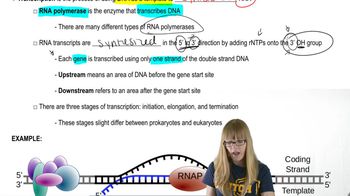
Overview of Transcription

Guide RNA and Target Recognition

The CRISPR array is transcribed into RNA, which is processed into guide RNAs that match the viral DNA sequences stored as spacers. These guide RNAs direct the Cas proteins to specifically bind and cleave the complementary viral DNA during subsequent infections, preventing viral replication.
Recommended video:
Guided course
06:59
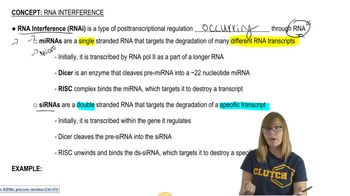
RNA Interference

Cas Protein-Mediated DNA Cleavage

Cas proteins, such as Cas9, act as molecular scissors that cut the viral DNA at the site complementary to the guide RNA. This cleavage disables the virus by breaking its genome, thereby stopping the infection and protecting the host cell from viral damage.
Recommended video: