
Pearson+ LogoPearson+ Logo
Ch. 4 - Modification of Mendelian Ratios
Klug - Essentials of Genetics 10th Edition
Klug10th EditionEssentials of GeneticsISBN: 9780135588789Not the one you use?Change textbook
Chapter 4, Problem 1e

Answer the following fundamental questions:
How was extranuclear inheritance discovered?

Verified step by step guidance
1
Understand that extranuclear inheritance refers to the transmission of genetic material outside the nucleus, typically involving organelles like mitochondria and chloroplasts.
Recognize that the discovery of extranuclear inheritance came from observing traits that did not follow Mendelian inheritance patterns, meaning they were not inherited through nuclear genes.
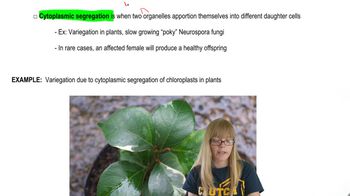
Study key experiments, such as those involving the inheritance of leaf color in the plant Mirabilis jalapa, where variegated leaf patterns were passed from the mother plant to offspring, indicating cytoplasmic inheritance.
Examine the work on mitochondrial inheritance in yeast and other organisms, where mutations in mitochondrial DNA affected traits independently of nuclear DNA.
Summarize that extranuclear inheritance was discovered through careful genetic crosses and observations of non-Mendelian patterns, leading to the identification of genetic material in organelles outside the nucleus.

Key Concepts

Here are the essential concepts you must grasp in order to answer the question correctly.

Extranuclear Inheritance

Extranuclear inheritance refers to the transmission of genetic material outside the nucleus, typically involving organelles like mitochondria and chloroplasts. Unlike nuclear genes, these genes are inherited maternally in most cases and follow non-Mendelian patterns.
Recommended video:
Guided course
05:13
Organelle Inheritance

Historical Experiments Leading to Discovery

The discovery of extranuclear inheritance arose from experiments such as those by Carl Correns and later studies on cytoplasmic inheritance in plants and animals. For example, the variegated leaf patterns in Mirabilis jalapa demonstrated that traits could be inherited through cytoplasmic organelles.
Recommended video:

Non-Mendelian Inheritance Patterns

Extranuclear inheritance challenged Mendel’s laws because traits controlled by organelle genes do not segregate according to Mendelian ratios. Understanding these patterns is essential to recognize how extranuclear genes are passed independently of nuclear chromosomes.
Recommended video:
Guided course
05:13
Organelle Inheritance
Related Practice
Textbook Question

In the discussion, we focused on extensions and modifications of Mendelian principles and ratios. In the process, we encountered many opportunities to consider how this information was acquired. On the basis of these discussions, what answers would you propose to the following fundamental questions?

How did geneticists determine that inheritance of some phenotypic characteristics involves the interactions of two or more gene pairs? How were they able to determine how many gene pairs were involved?

722
views
Textbook Question

The discussion centers on extensions and modifications of Mendelian principles and ratios. In the process, we encountered many opportunities to consider how this information was acquired. On the basis of these discussions, what answers would you propose to the following fundamental questions?

How do we know that specific genes are located on the sex-determining chromosomes rather than on autosomes?

446
views
Textbook Question

The discussion centers on extensions and modifications of Mendelian principles and ratios. In the process, we encountered many opportunities to consider how this information was acquired. On the basis of these discussions, what answers would you propose to the following fundamental questions?

For genes whose expression seems to be tied to the sex of individuals, how do we know whether a gene is X-linked in contrast to exhibiting sex-limited or sex-influenced inheritance?

505
views
Textbook Question

In shorthorn cattle, coat color may be red, white, or roan. Roan is an intermediate phenotype expressed as a mixture of red and white hairs. The following data were obtained from various crosses:

How is coat color inherited? What are the genotypes of parents and offspring for each cross?

1512
views
Textbook Question

With regard to the ABO blood types in humans, determine the genotype of the male parent and female parent shown here:

Male parent: Blood type B; mother type O

Female parent: Blood type A; father type B

Predict the blood types of the offspring that this couple may have and the expected proportion of each.

1325
views