Ch. 4 - Modification of Mendelian Ratios
Klug10th EditionEssentials of GeneticsISBN: 9780135588789
Not the one you use?Change textbookSelect a different textbook
Table of contents
- Ch. 1 - Introduction to Genetics16
- Ch. 2 - Mitosis and Meiosis28
- Ch. 3 - Mendelian Genetics37
- Ch. 4 - Modification of Mendelian Ratios53
- Ch. 5 - Sex Determination and Sex Chromosomes32
- Ch. 6 - Chromosome Mutations: Variation in Number and Arrangement37
- Ch. 7 - Linkage and Chromosome Mapping in Eukaryotes36
- Ch. 8 - Genetic Analysis and Mapping in Bacteria and Bacteriophages24
- Ch. 9 - DNA Structure and Analysis38
- Ch. 10 - DNA Replication29
- Ch. 11 - Chromosome Structure and DNA Sequence Organization22
- Ch. 12 - The Genetic Code and Transcription36
- Ch. 13 - Translation and Proteins27
- Ch. 14 - Gene Mutation, DNA Repair, and Transposition34
- Ch. 15 - Regulation of Gene Expression in Bacteria22
- Ch. 16 - Regulation of Gene Expression in Eukaryotes37
- Ch. 17 - Recombinant DNA Technology27
- Ch. 18 - Genomics, Bioinformatics, and Proteomics30
- Ch. 19 - The Genetics of Cancer21
- Ch. 20 - Quantitative Genetics and Multifactorial Traits37
- Ch. 21 - Population and Evolutionary Genetics45

Chapter 4, Problem 31b
The maternal-effect mutation bicoid (bcd) is recessive. In the absence of the bicoid protein product, embryogenesis is not completed. Consider a cross between a female heterozygous for the bicoid mutation and a homozygous male
b.Predict the outcome (normal vs. failed embryogenesis) in the and generations of the cross described.
 Verified step by step guidance
1
Identify the genotypes of the parents: the female is heterozygous for the bicoid mutation (bcd/+), and the male is homozygous recessive (bcd/bcd).
Understand that bicoid is a maternal-effect gene, meaning the phenotype of the offspring depends on the mother's genotype, not the offspring's own genotype.
Determine the possible genotypes of the F1 offspring by performing a Punnett square cross between the female (bcd/+) and the male (bcd/bcd).
Predict the phenotype of the F1 generation based on the mother's genotype: since the mother is heterozygous (bcd/+), she produces normal bicoid protein, so all F1 embryos will develop normally regardless of their genotype.
For the F2 generation, consider that F1 females may be either bcd/+ or bcd/bcd; only embryos from bcd/bcd mothers will fail embryogenesis due to lack of bicoid protein, so predict the ratio of normal to failed embryogenesis accordingly.
Key Concepts
Here are the essential concepts you must grasp in order to answer the question correctly.
Maternal-Effect Genes
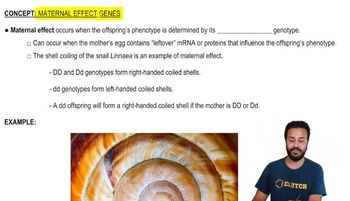
Maternal-effect genes are genes whose products, usually mRNA or proteins, are deposited by the mother into the egg and influence early embryonic development. The embryo's genotype does not determine the phenotype; instead, the mother's genotype controls the trait. In the bicoid example, the presence or absence of bicoid protein from the mother affects embryogenesis regardless of the embryo's own genotype.
Recommended video:
Guided course
 03:38
03:38
Maternal Effect
Recessive Mutations and Heterozygosity
A recessive mutation requires two copies of the mutant allele to show a phenotype. A heterozygous individual carries one normal and one mutant allele but typically shows a normal phenotype. In this cross, the heterozygous female produces eggs with either normal or mutant bicoid mRNA, affecting the embryo depending on which allele is inherited maternally.
Recommended video:
Guided course
 04:46
04:46Cancer Mutations
Genetic Crosses and Generational Outcomes
Predicting outcomes in genetic crosses involves understanding allele segregation and inheritance patterns across generations. Here, crossing a heterozygous female with a homozygous male affects the F1 generation's embryogenesis based on maternal genotype. The F2 generation's phenotype depends on the genotypes of the F1 females, illustrating how maternal-effect mutations influence successive generations.
Recommended video:
Guided course
 26:08
26:08Trihybrid Cross
Related Practice