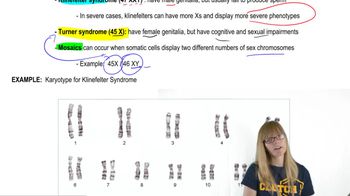
In mice, the Sry gene is located on the Y chromosome very close to one of the pseudoautosomal regions that pairs with the X chromosome during male meiosis. Given this information, propose a model to explain the generation of unusual males who have two X chromosomes (with an Sry-containing piece of the Y chromosome attached to one X chromosome).
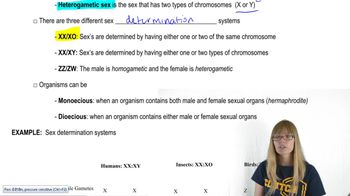
In chickens, a key gene involved in sex determination has recently been identified. Called DMRT1, it is located on the Z chromosome and is absent on the W chromosome. Like SRY in humans, it is male determining. Unlike SRY in humans, however, female chickens (ZW) have a single copy while males (ZZ) have two copies of the gene. Nevertheless, it is transcribed only in the developing testis. Working in the laboratory of Andrew Sinclair (a co-discoverer of the human SRY gene), Craig Smith and colleagues were able to 'knock down' expression of DMRT1 in ZZ embryos using RNA interference techniques. In such cases, the developing gonads look more like ovaries than testes. What conclusions can you draw about the role that the DMRT1 gene plays in chickens in contrast to the role the SRY gene plays in humans?
Verified step by step guidance
Verified video answer for a similar problem:
Key Concepts
Sex Chromosome Systems in Birds and Mammals
Role of DMRT1 and SRY Genes in Sex Determination
Gene Knockdown and Functional Analysis
The genes encoding the red- and green-color-detecting proteins of the human eye are located next to one another on the X chromosome and probably evolved from a common ancestral pigment gene. The two proteins demonstrate 76 percent homology in their amino acid sequences. A normal-visioned woman (with both genes present on each of her two X chromosomes) has a red-color-blind son who was shown to have one copy of the green-detecting gene and no copies of the red-detecting gene. Devise an explanation for these observations at the chromosomal level (involving meiosis).
In mice, the X-linked dominant mutation Testicular feminization (Tfm) eliminates the normal response to the testicular hormone testosterone during sexual differentiation. An XY mouse bearing the Tfm allele on the X chromosome develops testes, but no further male differentiation occurs—the external genitalia of such an animal are female. From this information, what might you conclude about the role of the Tfm gene product and the X and Y chromosomes in sex determination and sexual differentiation in mammals? Can you devise an experiment, assuming you can 'genetically engineer' the chromosomes of mice, to test and confirm your explanation?
